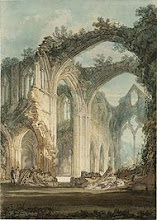
The romantic legend of Wild Humphrey Kynaston obscures the real man like a facade. Events from his life have either been interpreted through the legend or just forgotten.(1) I went on the trail of an outlaw – the historical figure behind the legend. There are gaps but we now have a much clearer view of the real man and his activities.
One of the earliest published accounts is Richard Gough's The Parish of Middle (1700). Gough wrote: ”He had two wives both of so mean birth, that they could not lay claim to any coat of arms....I have not heard of any children which Wild Humphrey had but I have heard of much debt that he had contracted; and being outlawed in debt, he left Middle Castle (which he had suffered to grow ruinous for want of repair), and went and sheltered himself in a cave near to Nescliffe.... and of him the people tell almost as many romantic storyies, as of the greate outlaw Robin Hood.”
In his book on Robin Hood (1725) Joseph Ritson wrote a similar desacription of the more famous legend: ”His extraction was noble ...In his youth he is reported to have been of a wild and extravegant dispposition, insomuch as his inheritance bing consumed or forfeited by his excesses, and his person outlawed for debt... he sort an asylum in the woods and forests ...”
 The main features of Humphrey’s legend are collected in several books like Shropshire Folklore, by Charlotte S. Burnes (1895): ”On the steepest side of Nescliffe Hill, overlooking the high-road from Oswestry to Shrewsbury, is a large cave in the face of the rock, approached by a flight of steps, and divided into two rooms by a pillar or half-wall of rock. It is well-known in all the neighbourhood as Kynaston’s cave, once the dwelling of “Wild Humphrey Kynaston”, a veritable high-born outlaw of Henry VII's time, who is still remembered by the poor as a very clever man called Kinnyson, who robbed the rich to give to the poor, and sold his soul to the devil for a marvellous horse.” This cave is signposted to guide tourists to its door.
 In Kynaston's time lots of people lived in caves. Dick Turpin is also said to have sojourned in a cave in Epping Forest!
The“Marvellous Horse” is a common feature of Highwaymen legends and Dick Turpin reputedly made an incredible dash on Black Bess from London to York for an alibi because at that time no one would suspect one in York of having committed a crime so soon before in London. This feat had previously been attributed to Swifty Nevison.(2) Even the legend of Hereward the Wake has acquired a horse posthumously.
Another with a marvellous horse was Exmoor outlaw Tom Faggus, who was used as a character in R.D. Blackmore’s “Lorna Doone.” His “marvellous horse” was a strawberry roan called Winnie. There is a story that on South Molton Bridge, on seeing pursuers in front and behind them, they leapt from the bridge into the River Mole below. This is similar to one of Humphry and Beelzebub leaping into the River Severn from the old Welsh Bridge. A better known feat is that after leaving Shrewsbury for his cave, Kynaston's pursuers had removed the wooden slats of the bridge at Montford to stop him crossing the River Severn. He spurred Beelzebub and they leapt the gap to safety. The significance is that Montford Bridge was the boundary between the liberties of Shrewsbury, and the Welsh Marches.
Humphrey's horse was reputedly shod backwards to fool pursuing lawmen. This trick was also attributed to Fulke Fitz Warrin III and Herne the Hunter. There are stories that his mother used to take his Sunday dinner to him in his cave and that grateful locals kept his horse stocked-up with hay.
 He was apparently descended from Welsh prince Bleddyn ap Cynfyn and born c1470 to Sir Roger Kynaston and an aristocratic mother Lady Elizabeth Grey, daughter of Antigone Plantagenet, daughter of Humphrey Plantagenet, Duke of Gloucester. The Duke of Gloucester was Humphrey's maternal great-grandfather and his first cousin was Lord Powys.
Sir Roger had been married previously c1450 to Elizabetha Cobham, born c1435, daughter of Richard, 7th Lord Strange and Danielus Cobham of Sterburgh Castle and Richard, 7th Lord Strange. Humphrey's elder half brother Sir Thomas, was son from this marriage. He held many high offices later in life including Sheriff of Shrops 1508-1510, Baliff of Shrewsbury 1511 and an agent for the Council in the Marches. (3)
There are some helpful documents printed in The Transactions of Shropshire Archaeological and Historical Society which point the way to the outlaw. The Last Will and Testament is a means to judge other events. In it he wished to be buried in St. Mary's church, Welshpool in the High Chancel, on the right side. (4)
It refers to lands he owned but only those in the desmene of Knockin are named. It was dated 1st May 1534. He was sound of mind but sick in body.
He left nothing to his first wife Marion because her father William ap Griffin ap Robyn had never paid her dowry of thirty pounds sterling. His second wife was Isabella daughter Meredudd ap Hwyl ap Morys of Oswestry.
The Kynastons were subjects of a special Act of Parliament. It is general and speaks of "... the greater abomination as well as murders robberies, and other great and offences committed and done by Thomas, Humphrey, Oliver and Richard Kynaston, as well with proclamation as otherwise; the which privy seals, contrary to their true allegiance and fealty, they have disobeyed, to the great contempt of his highness…therefore be it enacted by the king our sovereign lord, by the advise of the lordes spirituall and temporall and the commons, in this present parliament assembled…that writes of proclamation be made out of the Chancery to the sheriffs of the City of London and Shropshire and Humphrey and company be brought before the King’s highness in his court of Chancery. If they do not appear they shall lawfully but outlawed of felony and forfeit life, goods and land. (5)
The soundest way to follow the trail of the outlaw is through Star Chamber documents (Stacs) which are invaluable aids to researching medieval history. The Star Chamber court was set up by Henry VII to try criminals who were too powerful to be brought to justice in their own area. The conflicts the historical man was involved in were with Marcher Lords, the Council in the March. (6) The Welsh Marches had been a lawless no man's land “where the King's writ did not run” and misacreants could easily find sanctuary. Now the kings were passifying the area with Star Chamber and Princes Council which became the Council in the March.
The act of outlawing the Kynaston's seems to stem from an order from the King to the Sheriffs of London to make proclamation within the city and suburbs of London:
“... the King considering the abomination of murders, robberies and other offenses disobediences to his command, committed by Thomas, Humphrey, Oliver and Richard Keveston, gentlemen of Shropshire, contrary to their allegiance, by advice of parliament on November last, ordered that after writs of parliament issued to the sheriffs of London and Salop (Shropshire), the said parties should appear before his highness within fifteen days … to answer charges against them: and should they fail to appear, then they shall be adjudged as persons outlawed of felony and foreit life, goods and lands as if lawfully outlawed by course of law."
The Act is in The Calendar of Close Rolls for 23rd December 1487.
The Murder of Sir Thomas Kyffin
This murder is the subject of three Star Chamber documents. It is stated in a royal proclamation from the king to the bailiff’s of Oswestry: “Thomas and Humphrey Kynaston sons of Sir Roger to appear before the king and his council to answer to heinous murders by them on Sir Thomas Kyffin priest." The language of this document is standard. The King ordered: "that… no person nor persons retain…victual…money lodging or otherwise….And also our said souveraign lord will and straitly charge command all his officers liegeman and subgittes of what degree..,to take and put under arrest and save ward…them with all their adherents and supporters accessories and partners of the …murder and riots."
This proclamation was made under privy seal at Kenilworth Castle on the 10th of May in the second year of our reign”.(1486) They were probably outlawed for not appearing as commanded.(7)
We gather from the records the raids were carried out after the harvest barns were full. The rector was the one responsible for storing the grain and a receiver was the lord's servant responsible for gathering the lord's produce and profits.
At this time “Sir” was courtesy title for a non-graduate priest as well as a knight.
There are two Star Chamber documents on the murder of Sir Thomas Kyffin, to cardinal Wolsey legate a latere Archbishop of York and Lord Chancellor of England.
The language used in these documents is a great pleasure to read despite the variable spelling.
Stac 2/23/236: “In most humble wise complaining to your grace your daily orator and bedeman Edward Kyffyne sole admynster unto Sir Thomas Kyffyn priest late receiver unto my lord of Arundel at Oswestry in the marches of North Wales ..in the first year of the reign of Henry VIII" (1486).
Humphrey and "24 outlaws and other persons came to the castle of Oswestry at midnight and Sir Thomas and others were compelled to yield to Humphrey and when yielded were murdered as was the porter. Humphrey took away £200 in money, plate and apparell and soon after... went to Felton Aber took away corn to the value of £60 of the proper goods of Sir Thomas who had to account yearly to the Lord. Arundel and his auditors one Thomas ap Richard and many others were bound surety unto the Lord and also to the abbot of Shrewsbury for a farm."
After Thomas's death the sureties were called upon by Lord Arundel. Edward explains that he wants them "to appear before the lord and make answer so he can come and go safely for his life is in danger every day from Humphrey." Edward also says he was tender of age when the incident happened.
Another Stac (Stac2/31/70) is from Arthur Newton, nephew of Kyffin, to Wolsey. ”… malice and evil will one Humfray Kenyston brother to Thomas did feloniously kill and murder one Sir Thomas Kyffin parson of the church of Felton uncle unto your said beseecher.”
Humphrey had been ordered to pay 200 markes to the parsons kinfolk and had gathered much more from his friends but not paid it. “The orator is the next kinsman of the ... parson alive. He asks his grace for letters of privy seal to be sent to Humphrey commanding him to appear before your highness at the Star Chamber to answer to the premises."
The plaintiff says as he is sole administrator he is daily called upon by the sureties for their money back. The plaintiff wants the king to grant “a privy seal for Humphrey and his aforesaid servants to appear before your grace with other of the King's honourable Council “so providing your said orator may come and go safely for he was in doubt of his life from Humphrey and his retinue.”
The document ends with an order from Wolsey stating that the parties shall appear before king and his council at the palace of Westminster within 15 days of Easter next, under penalty of £100 each.
The Transactions of Shropshire Archeological and History Society Series 2, Vol.X (1898) printed his last will and testament. Humphrey shows remorse for the murder of Sir Thomas Kyffin: “Also I declare that Richard ap Reece of the town of Oswestry has made in general acquittance respecting all my documents and bonds made by me and my bondsman to the said Richard to Master Richard Kyffin John Kyffin clerks and to Ieuan Lloyd gentleman concerning the death of Master Richard Kyffin rector of Felton ...“
The Public Records Office has this killing dated as 1509 but Lord Arundel replaced Thomas Gryffin on his death in 1486 with one Thomas of Oswestry. (8)
The Lord of Oswestry was Thomas FitzAlan, 17th Earl of Arundel, 7th Baron Maltravers (1450–1524). He married Margaret Wydeville (or Woodville), who was a younger sister of King Edward's wife, Elizabeth.
STAC 2/26/343 is the charges against Meredudd ap Hwyl ap Morys and his followers of riotously taking the castle without the knowledge or authority of the Lord riotously entered the Lord's castle of Oswestry with force and denied entry to the Lord's officers and servants.
When the Lord knew of this he commanded Meredudd to leave but this he refused to do and forcibly retained it. When the Lord knew this he sent his auditors and other councillors to discharge him so that they might keep his receipts and accounts from that area. He kept them out with force and would not allow them to sit in the Lord's exchequer.
After the Lord had got Meredudd and his followers out he was advised to appoint Jevan ap “a substantial Gentleman of good name and true disposition Constable and gave him authority by his letters patent to keep the castle without the misrule that had been there.” When Jevan came to enter the castle to proclaim his patent as was the custom, Meredudd and his followers returned and beseiged the castle so that the Lord's servants inside were forced to give it up to him. Meredudd is then accused of taking away all the stuff of the Lord's that was within. He is also accused of robbing Jevan's brother and imprisoning him until Prince Arthur, the eldest son of Henry VIII, who was at Ludlow Castle at the head of the Prince's Council, the forerunner of The Council in the March, ordered him to be released. (8)
STAC2/2/... is Mereddud’s reply to the charges. He said that John Leighton squire had the keeping of the castle for a long time by grant of Lord Arundel and Leighton had made him deputy and bound him by £200 surety and to re-deliver to no one but John which is why he entered the castle to keep it. However, Arundel committed it to the keeping of persons who were "favourers of outlaws and rebels to the utterdestruction of all the country thereabout." Leighton knew this and put Merddud in out of trust. King’s cousin Sir Richard Pole (d.1505) was governor of the Marches and wrote to Mereddud saying he would be warrant unto the king. Then the said evil persons by subtle and crafty means caused several of the lord’s officers and servants to desire Maredudd to come into the castle to keep the outlaws and rebels out. The rebels and their accessories and succourers were fewer than 8 persons. The rebels commanded Meredudd to leave the castle but he would only to Pole or Leighton. (9)
Then John Royden the sergeant-at-arms was commanded to attend the castle by the Lord Chamberlaine and he installed Roger ap David. Mereddud then denies keeping the castle or the presidents and records from the auditors of the lord. Soon after Humphrey and Thomas Kynaston "gathered a great number of rebels and outlaws and by subtle means at night time caused 42 to be privily conveyed in to the castle and forcibly eject Davyd."
The King sent letters by privy seal to be read and shown to the Bailiff of Oswestry and all officers, liegeman and subjects charging them to capture Humphrey and Thomas with their adherents, accessories and partners.
Mereddud said he was a bailiff, and they gathered a great company and went to take the outlaws and during the skirmish Yevan was killed.
Mereddud claims he was a mile or more away from the scene. He also says he was sorry as they were near of kin while Humphrey and Thomas Kynaston were distressed and put to flight.
Then the Bailiiff’s, officers and subjects returned to Oswestry and the rebels within the castle surrendered when they heard thet Humphrey and Thomas were distressed. There was no fine or ransome taken by Mereddud, nor did he lie in wait.
In STAC2/23/180 the plaintiff Margaret claims to be Jevan's widow, but is revealed as Humphrey's sister. She claims that her late husband departed from his home in Abertanat on the 22nd of October in the 8th year of the King's reign (1493) for Oswestry Castle where he had been appointed constable and deputy by the Lord. He was waylaid by Meredudd ap Hywl ap Morys, gentleman and rebel, and his followers accompanied by John Puleston and misruled persons. She claims that there were 1500 misruled persons arrayed in manner of war with bows, arrows, longe spears, swords of prepensed malice without ground or cause laid wait for her late husband. They murdered him, slew one of his assistants and hurt many more.
After the murder Meredudd with his company went to the castle and with great riot and force broke and entered and took certain goods of Jevan ap David Lloyd and hers which she claims was worth £100. She asks for the murderers and felons have such punishment as other like offenders may take example thereby.
John Puleston's response to Margaret's complaint is Stac 2/24/213. He states that Margaret is really sister to Humphrey and Thomas and that Jevan was married to Maud who is still alive.
"It had been shown to many of the King's subjets that Humphrey and Thomas had long been proclaimed outlaws and rebels for many offences and never obedient to the King and that they were coming to Oswestry with a great company of outlaws and rebels to destroy the town and country around.
"Humphrey and Thomas had committed many felonies and murders in the town. The people living in the area were in great dread of them coming and sent for many of their friends and kinsmen to help them defend themselves. John claims that they also sent for him and that he and his company went to Oswestry thinking that he would deserve thanks from both God and King."
When Humphrey and Thomas "came towards Oswestry to the town's end with outlaws and evil disposed persons to the number of 1500. A hundred were in white harness (armour for men and horses) with weapons to murder and slay many of your subjects as they had done before. Jevan was in their company but this was unknown to John." The Duke of York had white livery and this suggests these were Yorkists rebels. Sir Roger Kynaston had been an official of the Dukes including Constable of Denbeigh for him. Prof. R.A.Griffiths showed he was one of the Duke's retainers.(10)
John declared that he and about 2,000 of the King's faithful subjects gathered to defend the town and this force fought and put them to flight. It was then he said that Jevan was killed but he knew nothing of it. He added that Jevan was close kin and that he owed him great favours and would have taken his part for the office of constable if he had come himself and not in the company of Humphrey and Thomas. Even so he had nothing to do with the murder. He also denied breaking into the castle or taking goods therefrom and had only helped the King's subjects to withstand the attack and that Margaret bears him malice. He asks that this be dismissed with reasonable costs and damages sustained by this wrongful vexation.
There are depositions of witnesses on behalf of Lord Arundel. One David Edmunds was chaplain and receiver to the lord. He was examined on the 6th of January, He swore that for 2 years last May the Constable of the Castle had been Roger ap Davyd till the lord dismissed him by writing which was delivered by Mereddud, and then Yevan was appointed. This was brought to the attention of William Corstlaker pursyvant to the lord with certain bonds.
This version is that ap Davyd refused to depart. It was that night that Mereddud and his followers besieged the castle with people in harness and would not allow meat or drink in. This also relates that an appointment was taken between Meredudd and Yevan until Tuesday next distent. This deponent and other came to town on a Friday where it was shown that the Lord Chamberlayne wold not sufer the appointment of truce. It is unclear from this statement how events unfolded but he says that a truce as agreed by Mereddud and Yevan till the next Tuesday. But the Lord Chamberlayne would not allow the truce and said he wold shortly charge (?) and Yevan should be put out of the castle again. Then Mereddud and his followers besieged again with scales and instruments of war.
In Stac 2/18/207 contd Richard Blodwell Vicar of Blodwell 4 mile from Oswestry deposed that he was in Oswestry on many occasions and heard different people a David & a Cook…servants of Arundel command Mereddud to give up the castle but he kept it by force of arms. It was then that Yevan Lloyd gentleman was made constable and upon Michaelmas was coming from Blodwell with his letters patent to execute his office when Mereddud with about 50 persons, slew him and took this deponent and took a pouch from him which held a sum of money and box which contained the letters patent.
Merddud took Yevan’s brother and sent him to Chirk Castle with others and imprisoned him. He alleges that Mereddud took the goods of many poor tenants who had followed Yevan without shoes on their feet, to see him take possession of his office and took from the castle their harness, their bedding and household goods.
John a Weston aged 70 a husbandman of Shrawardyne said that he was there with a William Baret at Aston and saw what William saw and heard but could not say more.
Mores ap John aged 26 who lived within a mile of Oswestry said that the day and night before Yevan was killed Mereddud had heard that he wold be coming to proclayme his patent of the Constableship of Oswestry and gather many persons in harneys ….
Stac2/18/207 contd has William Baret also of Shrawardine Justice…(of the peace?) aged 50 deposed that Mereddud had the keeping of the castle but did not know by what authority. But he did know that officers had tried to discharge Mereddud to put another in, but he would not leave. He adds that later Maredudd was removed and he thinks by Yevan with much strife and great hordes of men fighting and being killed … he adds that Thomas and Humphrey were not present at the murder because he met them a mile and a half from where Yevan was killed in harneys and wayfaring but not going forward or back. While he was in conversation with them a great shout went up and 3 persons came fast riding…
The story is developed in Stac2/18/207 contd when Richard Bailiff of Oswestry also stated that there were writings from the lord to discharge Merdddud and put in officers. He repeats the story about refusing victual to those within and that Yevan was slain by Mereddud and his company but did not know how. It was true he added that the poor people who had followed Yevan were taken and ransomed. He himself was suretie for one at £10, which was paid to Mereddud.
The History of the Gwydir Family(1927)Page 41 gives a picture of Meredudd and how escaped felons fared: “In those days in Chirkland and Oswestry, two sects or kindreds contended for the sovereignty of the country and were at continual strife, one with another, the Kyffins and the Trefors. They had their alliance, partisans and friends in all countries round thereabouts, to whom, as the manner of that time was, they sent such of their followers as committed murder or manslaughter, who were safely kept as very precious jewels, and they received the like from their friends. This kinde of people were stowed in the daytime in chambers in their houses and in the night they went to the next winehouse that belonged to the gentleman or to his tenants houses not far off to make merry and wench."
Maredudd ap Hywel ap Morys, in those days, chief and leader of the sect of Kyffins, was a kin to Ievan ap Robert and in league with him; to whom he sent to desire him to draw a draft to catch these murderers. He sent him word that he should come privately into Chirkland accompanied but with six, and he made no doubt to deliver the murderers into his hands... and if they were brought to Chirk Castle gate to receive the trial of that country's laws it was lawfull for the offenders friends to bring £5 for every man to the Lord and acquit them, so it were not in cases of treason. A damnable custom used in those days in the lordships marchers … until the new ordinances …
“In those days it was the manner that the murderer only he that gave the death wound should only fly, which was called in Welsh, a Hawrudd, or red hand because he had bloodied his hand. The accessories and abettors to the murder, they were never hearkened after.”
The Lord Chamberlaine was Sir William Stanley, who owned Chirk Castle where Jevan's brother was imprisoned. In 1490, Henry VII granted the lordships of Chirk, Bromley and Yale. It is likely that his influence in Powis helped marginalise that of Sir Roger Kynaston because he would not likely have welcomed the letter from the future Henry VII Machynlleth on August 14 commanding him to “come with the folks and servants of John, Lord Powis to assist him" fight for the Crown. He was later executed in 1495 as a conspirator in the Perkin Warbeck affair.
 In his tours of 1540 John Leland described Stretton Dale, now known as Church Stretton, as belonging to Lord Arundel. Records at Loton Hall in “Copies of Deeds” page 31, states that John resided at Stretton-in the-Dale which is where the following “Laying in wait” took place.
The Kynaston gang raided Stretton and murdered one of his men which is related in The Transactions of Shropshire Archeological and Historical Society 2nd series, Vol.XI (1899) in a Coroner’s Inquest and Inquisition. On Wednesday before the Feast of Christmas in the 7th year of the reign of King Henry the seventh after the conquest (1492). These were held in front of the body of one murdered and would have followed the “Hue and Cry” on the arrival of the coroner.
The King had written to the Coroner a writ per ti mitti asking him to send the Inquisition report which he does as was usual was sewn to an Indictment. The writ asks for the “Indictment touching the death of John Heughes lately taken before you upon view of the body”. It asks for Humphrey and the others to be called. It is dated the 23rd day of January in the 8th year of our reign (1493).
The central action is a “lying in wait”. It reads, “before Humphrey Blyke one of the King’s Coroners upon view of the body then and there lying killed.” Under oath the jurors said that “Whereas John Heughes was in the peace of God and the King, there Humphrey Kynaston late of Nescliffe, late of Knockyn, late of Pole (Welshpool) in the Marches of Wales to the same county of Salop adjacent; Thomas Kynaston, late of Shrawardine and Robert Hopton, labourer, late of Hopton in the parish of Nescliffe, in the county of Salop.
"Humphrey riding upon a horse with a certain lance worth 12 pence, which he had in his right hand, rode at Heughes and struck him on the right side of his breast which killed him. Thomas Kynaston with a sword worth 40 pence, then struck the dead Heughes on the left side of his head. Hopton then struck him with a bill worth 10 pence, on the calf of his leg. The jurors also say under oath that Robert Thornes late of Shrewsbury, in Salop, aided and abetted." Outlaw gangs were led by a nucleous of kin, often brothers. The Visitations of Shropshire 1623, a collection of family pedigrees, shows Robert Thornes to be married to Humphrey's full-sister Jane.
Robert Thornes, Sir Roger Kynaston and 34 others are accused of while knowing the 3 had committed the felony, feloniously received, comforted, lodged, fed and maintained them at Pontesbury, Shrewsbury and Nescliffe.
 Outlaw gangs were run by someone higher up the social scale. As they were gentry themselves it is usually a Lord. Here, though we have only the father of the two principles actually named, yet we see a certain Jevan ap David Gethyn, late of Abberbury and Reginald ap David Gethyn of Maesbroc and these were also cited in the Battle of Oswestry documents. Jevan is the Constable murdered on his way to take up office in Oswestry.
Hugh Walker and Edward Hosyer, had “Mar” written above their names which signified that they were in the Marshalsea prison in London. If they had turned King’s evidence it would have had “approver” added. This shows they had been arrested. They had been Bailiff’s of Shrewsbury.
One of the jurors, incidentally, was a William of the inne, which last two words conflated into Thynne - he was an ancestor of the present Marquess of Bath.
There are several Pardons in existance in Edward Sutton Lord Dudley's notebook held at the British Library that might refer to the outlaw or his first cousin who was also Humphrey Kynaston. You distinguish them by place: Wild Humphrey is Nescliffe or Oswestry, Cousin Humphrey was of Stokes or Otely in the Ellesmere area. However there is one addressed specifically to Humphrey of Nescliffe in the twentieth day of May in the eighth year of our reign (1493).(11)
His last Will and Testament requested he be buried to the right of the high chancel in St. Mary's Church, Welshpool but when the church was refurbished in 1856 and the bones of those intered there were dug up and later re-buried there was no mention of Humphrey. The Will was dated 1st May 1534. He left all his land and tenements in England and Wales to his eldest son, Edward, but the demesne of Knockyn was enfeoffed to his younger son, Roger, and wife.
The Bonds of Statute Merchant 12 Henry VII. 3365/67/62 held at Shropshire Records and Research Centre give Humphrey's address as Nescliffe in 1496-1501 23 Dec. Humphrey Kynaston of Nessecliffe, Esq., acknowledged his bond to Thomas Kynaston of Fenemere and Helen his wife, for £40 to be paid at the Feast of the Purification of the Blessed Virgin Mary next following.
Another bond in the Bonds of Statute Merchant collections at Shropshire Records and Research Centre shown his widowed mother, Lady Elizabeth Kynaston, as living in Welshpool and Humphrey in Nescliffe. It was recorded that from 1507 that Humphrey owned 10, High Street, Welshpool which passed to his direct descendents.
The Williamse MS in Shropshire Records Office reproduces deeds which show the high esteem in which the Lord held Humphrey. They are grants of villas. One grant reads: By the good service of our beloved cousin and appears to be another grant of land for good services.(43b)
A deed mentions John Trevor's marriage to Humphrey's daughter by his first marriage. (12)
The Montgomeryshire Collections on deeds of Lord Dudley shows him as Lieutenant of Powys. That is one who acts in place of or represents a superior, an assistant or deputy. He is witness to two deeds given by Edward Sutton, Lord Dudley, part owner of Powis lands. The first is on 5th August 3 Henry VIII (1511), at Welshpool, the second September 4 Henry VIII (1512) at Dudley.
He may have been in charge of mustering the local troops for the king, which inclines me to the view that it was he who took a hundred men to serve the king in France, not his cousin. A Humphrey Kynaston and Thomas Trentham entered France in the King's army on 16th June 1513. ”Homfray Kynaston and Thomas Trentham a C men with out standard.” Humphrey appears to have been the captain, Trentham his petty captain. (13)
____________________________________________
(4) Transactions of Shropshire Archeological Society. The Last Will and Testament and a general pardon are in Series2, Vol.X (1898)
(5) Calendar of close Rolls. HVII. Vol.1 no.316 (1487) 23rd December
(6)
(7) Institutes in the Diocese of Lichfield and Coventry(1480-1543). Joel Lipkin. This is derived from the bishop's listings there.
(9) A direct decendent of John Leighton, sir Michael, lives at Loton Hall, Alberbury today. He is married to the mother of Guy Ritchie, film director and former husband of Madonna.
(10) See H.T. Evans, Wales and the Wars of the Roses (1915), 63 and n. 46; and R.A. Griffiths, The Reign of King Henry VI (1981), 820 and n.291.
(11) This Pardon printed in Calendar of Patent Rolls Henry VII (1485-1494) P336, refers to him by place, Nescliffe
(13) This is in Letters and Papers: Foreign and Domestic. HenryVIII Vol.1(1509-14)P609. It is clearly attributed to Humphrey son of Sir Roger of Hordley in The Visitations of 1623.
Several of these figures have been lauded by Welsh Bards in praise poetry. There is a translation of by Howel W.Lloyd of To Meredudd ab Hwyl ab Morys andbto the town of Oswestry by Lewis Glyn Cothi in Transactions, 2nd Series, Vol.VI.

 There have been some foolish demolitions in Stratford upon Avon and amongst the historic gems are some repulsive concrete blocks, although it is not quite as bad as Gloucester. The town is world-famous as the birthplace of William Shakespeare and needs to look like it did when he was alive but often the wrong values obtrude and like Liverpool they start spoiling what they should conserve. A great success in Stratford is the way national retail chains had to conform to the existing building rather than ruin them by sticking on their usual shop fronts. This is exemplary: it is an example of how our towns and cities can be conserved.
  My contention is that with a style of architecture that grew out of our traditions it would look even more impressive. The individual buildings often make use of fine geometrical shapes and the Lowry Gallery has semi circles. In themselves these geometric shapes are attractive but they bear no relation to the inspiration for the building nor its function. With modern buildings you get individual buildings out of relation to their neighbours. The main block of the Lowry Gallery on Salford Quays look as if it is falling down. A projection of our collapsing civilisation.
  If you compare these with the great British style of Tudor, in which buildings often hung over the street, you see the difference between character and muddle. The Shambles in York, for example, Corve Street in Ludlow and Park Street in Bristol which is from 1761 and was Bristol's first example of uniformly stepped hillside terracing. They all show harmony and balance which gives them not only beauty but character and grandeur, splendour and impressiveness, of appearance and style. At the top of the street there is a dramatic view of the Wills Memorial Building. These show harmony and essential balance in the streets. There are differences between individual buildings but because these differences are within a harmonious whole they create character not disunity and muddle. This balance has been maintained over the centuries.We find harmony and balance until architectural anarchy took over. (4)


 Inspectors from UNESCO and ICOMOS (International Commission on Monuments and Sites) visited Liverpool in October 2007 to, inter alia:
 In 1796 Shrewsbury entrepreneurs Thomas and Benjamin Benyon and John Marshall of Leeds purchased the rights to the newly invented flax-spinning machine. Ditherington Flax Mill was built in Shrewsbury were skilled workers were looking for work, excellent transport links with the canal and roads and a market for it’s products such as carpet weaving in Kidderminster and Bridgnorth.
 Most of these buildings have shoddy cladding which will likely only have an expected life of ten or so years. One luxury designer apartment development at Piccadilly Basin, Manchester already has problems with leaking rooves.