Friday, 16 April 2010

Aspiration through Art

(January 2010)


Our high traditions of sacred and imaginative Art have nearly died with the decline of religion and the spiritual uplift it brings to the artistic imagination and our higher natures. Religiously inspired art has been replaced by a negative attempt to destroy those traditions. The benefits of a firm common religion to art is the transforming of creative imagination into something higher and raising it above the base and the mundane. The driving force of our civilisation has always been creative imagination and the sense of striving for something higher while rooted in the human and everyday. Western civilization has largely sprung from a sense of piety and holiness and reverence for God and his creation and not just the need to secure one’s position in life. As, George Frederick Handel put it: “If I merely entertain them, then I have failed. I wish to make them better.”

The Avant-garde do the opposite and actually try to destroy the higher aspirations of art; they pour scorn on the high and noble to make them seem base and trivial. Those with influence promote this view and we seem not to have any spiritual defences. Ordinary people loath it, their reaction is instinctual, but the opinion formers make only mild criticism and generally accommodate the gradual destruction of our artistic traditions.

Our contemporary culture is unpropitious for nurturing the necessary outlook to renew civilisation - which needs renewing with each generation. There is a tendency to make a joke of everything and the general mood is to be frivolous, be facetious, trivialise everything. We see this on television programmes and in newspaper articles. People are frightened to make bold statements in defence of our civilisation in the face of Political Correctness and anti-Britishness. To represent us and our lives seriously is too much for the orthodox, conforming ones. They lark about like children in a classroom and bring sex into everything.

You expect a certain kind of artistic product but art today is often reduced to leg pulling. Recently, I was looking at an oil painting of a couple embracing near to an atmospheric steam train in a sort of "Brief Encounter" image. The description told us that the artist wanted us to question whether the couple were meeting or parting which reduced it to a childish puzzle.

Art is not treated with due reverence but belittled and undervalued if not used as a commodity for buying and selling. In his exhibition at the Cornerhouse, Richard Whitby, used Blu-Tack to hang the pictures. His reason is the work is largely produced in poster form, to satisfy his preoccupation with disposable, quick burn media and, more importantly, as a homage to the source of his images, many of which are taken from or refer directly to familiar advertising campaigns and methods: “The work reflects certain things I experience as someone who is living in contemporary society, by which I mean someone who visits shopping malls, goes on aeroplane flights, buys cinema tickets, looks on websites and is bombarded by advertising." There is an occupation with the trivial and no striving for something higher.

Artists often have technical ability but lack the imaginative ability to conceive something profound or higher. Glenn Brown has technical ability but appropriates images from other artists. His exhibition at the 2000 Turner Prize, had a painting based on a science-fiction illustration from Tony Robert's 1973 Double Star. In 2009, Brown claimed that "to make something up from scratch is nonsensical. Images are a language. It’s impossible to make a painting that is not borrowed — even the images in your dreams refer to reality." This shows a failure to understand inspiration which works through the unconscious or heightened powers of intuition and these are increased by a religious spirituality and reverence for the effects of real art whereas “appropriation”, or using other people's images is widespread in contemporary art and shows the limitations of the contemporary artistic imagination.

From the 60s contemporary art began merging with popular culture as in Peter Blake’s the famous LP cover for Sergeant Peppers Lonely Hearts Club Band by The Beatles. Artists are now promoted as stars and have agents arranging events and interviews for them.

Individuals and organisations can apply to the Arts Council for funding from its own budget or from the Lottery. Arts Council England is the national development agency for encouraging this attack on our civilisation. The selection of those awarded grants is based on prejudice against our traditional standards and values. Public money from the Government and the National Lottery is given to the arts organisations who share their ideology.

Contemporary art is not art and should be by rights called something else. But it is a financial asset for the global elites who buy and sell it and run the galleries and arts Councils that manage artistic creativity. It is exhibited by commercial art galleries, private collectors, corporations, publicly funded arts organizations, contemporary art museums or by the artists themselves who are supported by grants, awards and prizes as well as by selling work. These are interlocking and exclusive relationships. Individual members of the elite are highly influential - Charles Saatchi has dominated the market in British contemporary art for twenty years and is a major sponsor and collector.


I looked at one of my favourites: Vermeer’s View of Delft. How does it differ from contemporary stuff? There is no intent to provoke negative feelings and the vision is realised by a remarkable technical talent; the content is appropriately expressed by the form. It shows a beautiful partly cloudy sky in the early morning and beneath the skyline of Delft is clearly demarcated. There is a shaft of sunlight illuminating the rooves of the houses along the Lange Geer canal, the tower of the Church and a striking contrast between where the light falls and the tower and their shadowy surroundings that creates a sense depth. This masterpiece has luminosity and has produced awe in viewers since the 17th Century. On closer viewing, one can see that despite the clarity of light, it is raining, and water droplets splash on the water and cling to the rooftops. The image is of a cityscape that is united in the composition and enveloped atmospherically into glowing light of Vermeer’s hometown - an uplifting transformation through a great and artistically pure imagination of nature.

By contrast there is something disturbed, even evil, about the modern imagination that is promoted by art elites of the Arts Council and Turner Prize. The artists’ imaginations lack guidance from higher, spiritual sources and are corrupted. Channel Four show promotional films for this which they claim subconsciously influences the public. (1) They are acknowledging the corrupting power of contemporary art.

The Tate Modern “Pop Life”exhibition had a video installation of artist, Andrea Fraser, who paid a stranger $20,000 to be filmed having sex with her. There is a room of Jeff Koon’s giant canvases of sexual acts, another room is lined with images taken from pornographic magazines by Cosey Fanni Tutti, a former porn actress. We see a hackneyed similarity in subject matter and a lack of individuality among the anti-artists who are financed in part by public money appropriated from taxpayers to promote work that plays a part in reducing the moral barrier towards the sexual abuse of the publics' children.

A young woman told me that an exhibition at the Ikon gallery in Birmingham had photographs of people being sick. Her university tutors had recommended it to the students. Tutors like teachers are the promoters of orthodoxy and seem incapable of standing against fashion. She explained that now people think anything is art and the boundaries have gone. Well, yes, but the underlying motive is the destruction of our artistic tradition and the undermining of our civilisation. Is a urinal, say, an artistic subject? No, it is intrinsically unartistic, even though it might have pleasing curves, and to write about it as such does not make it artistic but conceptually separates artistic form from artistic subject.

Contemporary art degrades us by destroying our need for something holy to guide us. Every year these time-warped artists stage a ritual by setting up an ordinary member of the public. The script is this: an elderly person takes a youngster, say, grandchild or niece, to an exhibition and is shocked by something on display, like an unmade bed, and complains to the press. Then the curator is quoted as saying, “Art is to make people think, and to provoke feelings”. This hackneyed response has been used on each occasion for the last 30 years.

They use the names of proper artists like Turner to give them credibility but degrade the name. John Ruskin described Turner as the artist who did "stirringly and truthfully measure the moods of Nature." Sublime meant awe-inspiring and was related to the Sublime and Beautiful in aesthetic experience. By the late 18th century, the rationalist ideas from The Enlightenment were being overthrown by instinctual responses to beauty and sublimity. You do not look at a pleasing curved form and rationally decide it is beautiful - ones response is simply human instinct which comes naturally.

'Sublime' – the grandeur of nature demonstrated the power of God. Turner saw light as the emanation of God's spirit and he refined his later paintings by omitting solid objects and detail, concentrating on the play of light on water, the radiance of skies and fires and tried to express spirituality in the world not just a response to the physical view. His imagination transformed the physical view.

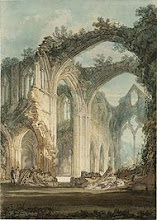
In early works, such as Tintern Abbey (1795), he followed the traditions of English landscape but by Hannibal Crossing the Alps (1812) had developed the tradition by introducing the destructive power of nature. He used watercolour technique with oil paints to create a light, almost weak representation of the scene and ephemeral atmospheric effects. In all these there is a striving after something higher.

But Tracy Emin reduces art to sex-themed works include a Zebra with an erection - a crankshaft that operates a model of a zebra, which in turn is copulating with a model of a woman in Victorian dress - the hackneyed image of prudery. It is pretentious and has no intrinsic merit - only that bestowed by the elites. If the Victorian woman were replaced with, say, Cherie Blair or Diane Abbott, the pseuds would be filled with shock and hysteria.

A main feature of contemporary art is paedophila. Grayson Perry is known for vases depicting the sexual abuse of children. David Bowie’s 1975 concept album “1.Outside” had a story about the dismemberment of a teenage girl. Bowie also promoted an androgynous image with the concept album Ziggy Stardust. It was the basis for his 1972 tour, which was sponsored by The Sun newspaper, and the gigs were filmed by BBC television.


This spreading of evil through art is exemplified by Marcus Harvey’s painting of Moors Murderer Myra Hindley who was jailed for life with her lover Ian Brady for the sadistic murders of four children between 1963 and 1964 which included taping their crying and pleas for mercy. Increasing the evil (and hurt for families and relations), Harvey's painting of Hindley was made using the handprints of children. With this on exhibition we get a glimpse of the corruption of the art Establishment.
"I'm a Celeb" contestant chef Gino D'Acampo has been charged with animal cruelty for beheading, cooking and eating a rat for a reality TV programme. He could face three years' jail. He and fellow contestant Stuart Manning, claimed to have caught and killed the rat before Italian Gino turned it into "rat risotto".

Australian police said the two were served with notices to appear at court on February 3 for the offence animal cruelty. In another reality programme participants ate live bugs and spiders. This behaving cruelly towards lower animals simply because they have been told to recalls the Millgram Experiment.

I wrote in “Contemporary Art and Reviving Civilisation” of how it seems we are descending to human sacrifices as art. I maintain art is only intrinsically artistic if it is something that produces an affect on our emotions ranging from pleasure to spiritual uplift. It triggers something aspirational or transcendent as the subject is transformed by human imagination and skill. Art begins as wholesome and aspiring to the spiritual, but in a declining civilisation it becomes both corrupted and corrupting.

Self-centred contempt for other people is widespread among art elites. Roman Polanski, the film director, was arrested in Switzerland for the rape of a 13-year-old girl in California 32 years ago - His actual crime was to drug and sodomise a 13-year-old girl.

He had admitted unlawful sex with a minor but escaped the US to France to avoid prison, yet many artists defended him. Film directors Woody Allen and Martin Scorsese called for him to be freed, writer Ronald Harwood, who wrote the screenplay of Polanski’s film The Pianist, defended him: “It seems to me very odd that America, which calls itself a Christian country, is so entirely lacking in the ability to forgive.” (See Mary Jackson's article, "Roman in the Gloamin' - Polanski's Murky Friends".)


Modern art elites are pretentious because they make grandiose claims for themselves, but their minor efforts belie their claims. Koons’s Exaltation 1991, which shows oral sex in close-up, and Glass Dildo 1991 is described by the Saatchi gallery as a “watershed moment in the interaction between the art world and celebrity culture”. Saatchi likewise describes the pornographic images of Fanni Tutti, as “rooted in a highly personal and mediated form of performance, enabling her to move from the porn and music industries to the equally reified context of the art world”. Of Andrea Fraser’s video of her having sex with a stranger in a hotel room it says: “By offering ‘herself’ up for sale, she pushes ... the viewer’s desire for intimacy with the artist to the logical extreme.”

The way to attract government grants is to conform to what the Arts Council(UK) want you to do. The elites promote exhibitions of flesh, skinned corpses, starving dogs and tins full of faeces.

This lack of substance gives a clue to what creates civilisation - confidence in one’s own people and the sense of the civilisation’s permanence. Traditional masterpieces have such individual detail and are so deep one is enrapt for the entire day after first looking at a work as a whole. We need belief in those values inherited from our ancestors and the confidence to transmit them to our descendants. We know that what gives meaning to life is our emotional experience, our relationships, our beliefs and values. Our values are bolstered by a sense of continuity: We receive them from our forbears. They tell us that we have long endured and we will continue to endure. The reverence and holiness that raise the works of art are transmitted to the viewers and outwards to communities as a whole and this revivifies civilisation; but now it is the opposite, as our civilisation is declining and the base are in influential positions, so everything is dragged down, tainted and destroyed.

Youngsters need courage to be different today. Not the kind of difference that means you sleep around at thirteen and can't stay married, or sober, for two minutes, that is encouraged by magazines and their promotion of celebs as role models, but the kind of individuality that enables you to say no thanks to the enormous attraction of joining the herd and getting the opportunity, fully paid for and approved, of attacking your heritage and your civilisation.

To combat the anti-art movement a young artist would need not only great talent but also independence of mind and an imagination developed through respectful study of tradition and a sense of reverence for God and his creation and the courage to stand alone against the artists and elites who have a stranglehold on artistic productions and the colleges that pass the fashionable methods on. The brave ones would need to study the great masterpieces and re-link themselves to appropriate traditions in order to begin reviving our civilisation.

Contemporary Art and Reviving Civilisation

The first thing that strikes one about contemporary artists is their general pettiness. Classical art provided something to aspire to not something to reduce. The problem with contemporary artists is that they do not know what subjects to paint - have no conception of what is an artistic subject. They offer well-painted trivia. Art became about the artist as celebrity, not about beauty; angst or social issues became "art" and now the mission is to merge it with pornography. The health of a civilisation is shown in its art. The comparison of some examples of contemporary art and the wholesome products of the dawn of European civilisation guides us in how we can revive this decaying inheritance of ours.

To contemporary artists Beauty is to be subverted. Avant-garde artists rejoice in shocking people like the elderly. Is that all they can do? This is financed by Global corporations and appropriating taxpayer’s money for the elites aims. The Avant-garde have a desire to be part of the latest thing but use the same old subjects and are dated.

A walk through Tate Modern and The National gallery opens up contemplation of good and evil, and how evil is being spread to our disadvantage in contemporary civilisation.

I looked at what early works in the dominant strand in contemporary art in the Tate Modern which act out ideology rather than embody profound intuitions or inspiration. The video “Meat Joy” by Carolee Schneemann from 1964 at the Festival de la Libre Expression in Paris. The title says it all about the delusion of free expression or pure art when content implies form and form should express content more clearly. "Meat Joy" claimed to be “exploring the gap between the conscious and unconscious, the real and the conceptual and an investigation and demystification of the hedonistic concept of the primeval ritual with its "excessive, indulgent... celebration of flesh as material." But it is no more profound explication of these ideas than the average porn film with which it shares form and content. Where the Avant-garde differs from porn is that it is pretentious and makes extravagant claims about itself in sentences of unfathomable abstractions.

For example, Hermann Nitsch was described as “The Pope of Viennese 'Aktionism'." It is said he shunned the illusionary confines of traditional painting and sculpture, reinventing an art that exists in real, corporeal, and violent terms. In the psueds language of the Saatchi Gallery “ Hermann Nitsch “… took the semblance of a pagan ceremony and incorporated robed processions, symbolic crucifixion, drunken excess, nudity, animal sacrifice, the drinking of blood, and the ritualistic incorporation of viscera and entrails.”

Judeo-Christian religion has always aimed to sublimate the dark side of human nature and artists used to transcend or transform it into something uplifting and inspirational but these anti-artists exhalt humanity's inner darkness: “The blank canvases incorporated as backdrops to his performances are sometimes smeared in blood, while others are violently attacked with symbolic red and purple paint. In the gallery, Hermann Nitsch's 'Splatter' paintings exist as holy 'relics': icons of metaphysical significance, radiating an aura of edification. They convey a terrible beauty, a sublime contemplation of life, violence, transgression and extremity.”

Action Pants: Genital Panic (1969) by Valie Export was describes by a critic as “A volatile mix of Fluxus happening, Situationist subversion, Viennese 'Aktionism, media critique, sexual politics and anarcho-terrorism the work continues to influence and elicit debate. A defiant gesture born of the turbulence of 1968, it teeters between ideological inspiration and hopeless nihilism. Problematic from every angle - is it an act of female empowerment or feminine hysteria? - Export’s anti-spectacle is, at heart, a paradoxical affirmation of the self via a masochistic (and militant) fragmentation and exposure.” The descriptions are as ever meaningless abstractions.

She dishevelled her hair, wore jeans with the crotch cut away and carried a machine gun then strode round the audience challenging the male audience to engage with a "real woman" instead of images on a screen. This was supposed to be an act of artistic daring - challenging the objectification of the female form by confronting voyeurs with a body that returned the gaze. As if the only time men see the female form is sitting passively in a dark cinema!

“In EXPORT's performance, the female body is not packaged and sold by male directors and producers, but is controlled and offered freely by the woman herself, in defiance of social rules and state precepts. Also, the ordinary state-approved cinema is an essentially voyeuristic experience, whereas in EXPORT's performance, the "audience" not only has a very direct, tactile contact with another person, but does so in the full view of EXPORT and bystanders.”

In "Facing a Family" (1971) a video broadcast in the Austrian television program "Kontakte", EXPORT presents a bourgoise Austrian family watching TV while eating dinner. The idea was that as other middle class families watched this TV, the television would be holding a mirror up to their experience and complicating the relationship between subject, spectator, and television. In fact it would be doing no such thing but embodying export’s passively received Marxist doctrine of hate for innocent middle-class people behaving naturally. It is merely acting out Marxist ideology and has no relation to Art.

Her Aus der Mappe der Hundigkeit E of 1968 shows a woman leading a man through streets on a lead. In this piece, negativity reaches its apogee in pure hatred and vengeance is celebrated.

State precepts still govern the anti-artists and the attacks on our civilisation are financed by sponsors and taxpayers money appropriated for The Arts Council (England) The Chapman brothers are conceptual artists who work together and have designed a label for Becks beer as part of a series of limited edition labels produced by contemporary artists. They were part of the Young British Artists movement promoted by Charles Saatchi, which included Damien Hirst and Tracey Emin.

The great tradition of British art and crafts has to be degraded. Whereas we have looked on William Morris’s works with positive feelings like joy or delight we now have as Charles Saatchi expressed it about Grayson Perry: “A ceramic object that is intended as a subversive comment on the nature of beauty is more likely to fit the definition of contemporary art than one that is simply beautiful.”

Perry’s “Golden Ghosts” were described by the Satchi Gallery:” Unhappy expressions on the little girls’ faces in Golden Ghosts contrast sharply with the idyllic country cottages stencilled in the background. Perry often uses found images to create a mood or a tension – the exceptionally sad image of the seated girl is that of a child affected by the Chernobyl Nuclear Power Station disaster. This evocative work hints at a familiarity with psychotherapy, made at a time when Perry was coming to terms with his own unhappy past. Perry’s transvestite alter ego, Claire, appears outlined in gold as the ghost in the title, dressed in the elaborate embroidered 'Coming Out Dress', made for a performance in 2000.”

These artists do not sublimate their unhappiness in their work but spread it to others. Unless we change this, we will inevitably decline so far as to accept animal sacrifice and mock-sacrifice, even human sacrifice portrayed as ‘art’.

Aliza Shvarts a 2008 Yale student did as “her senior art project, a documentation of a nine-month process during which she artificially inseminated herself “as often as possible” while periodically taking abortifacient drugs to induce miscarriages. Her exhibition will feature video recordings of these forced miscarriages as well as preserved collections of the blood from the process. “

I have previously written about this is a world-wide decadence promoted by international elites: In 2007, a Costa Rican ‘artist’ Guillermo Vargas Habacuc caught a stray dog on the street and tied it by a short leash to the wall of an art gallery and left it to die of hunger and thirst while cultural elites watched. The Central American Biennial of Art has decided that this was art and has asked Vargas Habacuc to repeat this “installation” at the Biennial of 2008. This was sanctioned by a public body run by the country’s elites. It is not clear that they really did starve the dog and it might be just to shock or get publicity to sell something. The final stage of civilisational collapse – depravity - is where we we’re at.

I later went to the National gallery and crossed “the bar” from the fetid and neurotic to a different plane – the positive and uplifting. The exhibits are deeper and meant to help people not degrade and offend. As things stand we are at the other end of the arc of civilisation, that of decadence and the negative attempt to destroy rather than a positive era of growth and this has to be changed.

The Early Renaissance rooms are awe-inspiring, not sickening, and transmit positive feelings - joy, transcendence and aspiration rather than misery, perversion and destruction. The sense of entering or aspiring to different consciousness is redolent in most works that go deeper than the media or the stories they grow from. A common feature is that they are set in a mystical light and symbols point to something higher and deeper about our existence than rolling around naked clutching fish or meat or blood daubed on canvases.

The creative imagination needs something to work on like fire on wood. This is what artists, poets, musicians, actors do. They use their art to create a world within the piece they're working on but the world is developed from a source.

These spiritually uplifting works in the Early Renaissance rooms have themes of rebirth, development and change of consciousness. There are several versions of Virgin and a Child - birth, creation; the Crucifiction, transformation; Transfiguration, a transformation of a man or woman into someone having the aspect of the divine.

The Santa Croce alterpiece shows rebirth; the Coronation of the Virgin is a change of state or consciousness through ritual and Jesus opening the eyes of a blind man is seeing anew and revelation.

One painting that inspires contemporary pilgrims, "The Annunciation of Saint Emidius", is profound and very expressive of significant meaning. The base it was developed from was the town of Ascoli though under papal rule when in 1482 Pope Sixtus IV granted it some self-government. It is an altarpiece and painted for the church of SS. Annunziata to celebrate the event. The coats of arms are those of the Pope (left) and the local bishop, Prospero Cafferelli (right). The News of Ascoli's increased status arrived on the feast of the Annunciation on 25 March, which made it an annunciation on Annunciation day and became a feast day when the town celebrated its greater liberty.

Redolent with symbolism it shows Saint Emidius, patron saint of Ascoli, carrying a model of the town. Ascoli is recognisable in the model Emidius carries. A holy beam of inspiration penetrates clouds passing through the lintel of a building and inspires Mary in prayer. There are two "town-planners" in the street outside – one has wings, the angel Gabriel, the other is patron saint, St. Emidus - are discussing a model of Ascoli. There is a dove in the beam just above her head. A Peacock which symbolises immortality is on the balcony above next to a potted plant on a tapestry. A caged bird is hanging on a rod to the left of the plant on the tapestry; another plant shrub is to the right of the peacock. The perspective of the sky is strange where the divine light cum sun beam breaks through the cloud to inspire Mary.

Compare this with symbols of decay and rotting flesh in the Chapman Brothers Turner Prize exhibit for 2003 “Sex” and “Death”. “Sex” referred to their previous work “Great Deeds against the Dead”. The original work shows three dismembered corpses hanging from a tree, “Sex” shows the same scene, but in a further state of decay. Clown’s noses have been added to the skulls of the corpses while snakes, rats and insects, similar to ones in joke shops, cover the piece. “Death” is two sex dolls, placed on top of each other, head-to-toe in the sixty-nine position. This the embodiment of the difference between good and evil. The former, wholesome, uplifting and inspiring; the latter death and decay.

The bridge between destroying art and developing it is represented in Salvador Dali’s career. His early work though fascinating and now legendary was often neurotic; his later Christian works are mystical paintings that create awe. He did not only paint Christian subjects but he did develop a mystical vision to embody in his remarkable technical ability; when he added profound content to form.

To contrast with the Avant-garde actors of ideology there is Dali's expressive rendition of the biblical Last Supper. He paints a three-D effect so inspiring that atheists and agnostics are moved by the depth and beauty of his technique and presentation of profound mystical insights. The transparent "stained" glass that encompasses Jesus and the apostles foreshadows the spiritual body of Christ ascending to the heavens. It is supurb juxtaposition and allegory in one panel. The foreshadowing indicates that the Last Supper was a stage towards the crucifixion. The three-d effect and the mystical sky, the body of Christ is emphasized by the lack of a head, arms outstretched over the Apostles symbolizes both that Christ offered himself up for us and that the Apostles and the Church by extension are the Mystical Body of Christ.

Unlike the contemporary Avant-garde anti-artists Dali developed from a decadent artist into one who conveyed awe and a sense of spiritual transformation; but Dali was a genius not just a trickster, and different from his contemporaries. His awesome technique developed from the traditional classical method.

It is for talented young artists now to return to spiritual transformation of our degraded and empty world to uplift people and revive our civilisation.

http://www.newenglishreview.org/custpage.cfm/frm/52492/sec_id/52492

Identity and Town Planning

10 November 2009

The collective hatred of our nation’s past by the leftist ruling elite takes practical form in their drive to erase all aspects of our culture, traditions and physical history — and is best illustrated by their physical erasure of our traditional architectural forms and its replacement with drab soviet-style ‘accommodation’.

This destruction of all forms of our national identity is engendered by a sense of shame which has been developed and perfected by the ruling elite during the course of the last century. They view all our previous cultural achievements as ‘bad’ or gained immorally at some other nation’s expense. As a result, they wish to eradicate our collective identity and deculturalise us from our roots.

A classic example was taking London Bridge to Lake Havasu, Arizona. It now crosses the Bridgewater Channel from the mainland to a small island on the Colorado River, is world-famous and draws visitors from all over the world. The bridge was sinking into the River Thames and should have been corrected but instead was sold to America. Robert P. McCulloch had the bridge dismantled and sent by barge to the California coast where it was loaded and taken by lorry to Lake Havasu and rebuilt ‘brick’ by ‘brick’. The bridge is a focal point for the city.

Near the bridge is an ‘English Village’ which pays respect to our culture. It has Tudor style architecture, and the shops and restaurants create the atmosphere of old England, with tree-lined walkways and local breweries for hand-brewed ale. There is an English pub in San Francisco — but in England they are being replaced by continental café bars!

For more than 140 years, London Bridge served as a crossing over the River Thames. It survived both world wars and a terrorist attack in 1884. If an American entrepreneur could do all that, then why could London council not conserve it? Because Americans have more respect for our traditions than our local authorities. American tourists constantly ask locals, “Why are you ruining your culture?” We are not — local authorities are imposing this on us.

There is also the eradication of our culture and its replacement by almost any other culture. We have seen the destruction of the traditional British pub, a centre of community and so much admired by tourists, for continental café bars. We see ‘Social Engineering’ by design, in schemes throughout the country whereby our towns and cities are having European style piazzas built to make us feel more European and thus less British. There was an attempt by the council to turn famous London landmark Sloane Square into a European piazza but a strong local opposition stopped it. People are born with an emotional need for community with their own kind and are not units to be re-organised to suit inorganic plans.

It is impossible to love cold, unnatural tower blocks or office buildings built along these lines, or places dominated by such buildings. But this is not just aesthetics; it is about our very identity, which is reinforced by the reciprocal relationship between people and the places in which they live. Building on what we have in a similar scale and style maintains continuity and helps to focus culture and identity. National and local governments alike are destroying places that are sanctioned by time and use, where communities have grown up and grown together instinctively. People’s natural bonding instincts are thwarted by high-rise buildings that separate them from one another and are not physically conducive to developing community spirit — the sense of belonging and of knowing with whom you belong.

Social engineering was to change the physical and mental environment, and thereby change people, who were seen as malleable. But people are not malleable — human nature needs familiar surroundings to develop and be happy. People react aggressively and destructively if this is denied.


Canadian Plains Indians, the Innu, were moved by the Canadian government into specially built estates. They were effectively forcibly transformed into Canadians, just as Britons are being forcibly transformed into ‘citizens of the world’. Like us, the Innu are having their past erased and are being offered nothing for the future — despair has set in, as it is setting in on Britain’s sink estates. A superficial difference is that the Innu were dispossessed by a different ethnic group (Canadian globalists), whereas we are being dispossessed by our own elected representatives (British globalists). But it is the same global movement. In the young Innu, deculturalisation manifests in drug and alcohol abuse and petty crime.

A parallel process is imposed here. In the same deculturalising vein, John Prescott issued a Government directive to destroy 40,000 terrace houses in England by dictat. Twenty thousand habitable homes in Liverpool were to be demolished and replaced by homes outside the range of the dispossessed locals. This is not the first time that ‘Scousers’ have been moved without thought for where they belong and uprooted and forced onto estates modelled on schemes in the Soviet Union.

A parallel with the Innu in England was moving ‘Scousers’ from their root in Liverpool to new towns like Skelmersdale. They should have followed on from traditional estates. Instead they were designed to separate vehicles from pedestrians with a system of courtyard layouts and cul-de-sacs emerging off spine streets, which led to disproportionate costs in street cleaning, refuse collection, ground and street furniture maintenance and, particularly, policing. Skelmersdale was built on an old coalfield and around a series of deep clefts in the moor side that go down into the middle of the town, which meant that extensive ground remediation and stabilisation was required for any construction.

It was built using innovative and experimental techniques — but these were deeply flawed, requiring expensive remedies. Many houses had central heating outlets in the ceiling. The fact that heat rises was ignored, so the bedrooms were heated moderately well but not the downstairs rooms. And one can punch a hand through walls because the houses’ metal frames are corroded and the concrete slabs have collapsed.

More and more of Britain’s young people are aimless, lacking in self-respect, without tradition or a sense of being part of something significant. They are being denied the inheritance of their forbears. There have always been people at the bottom of the pile, but they used to develop within a cultural tradition to which they belonged. Most young people do not misbehave out of endemic wickedness, but because they have been deculturalised. Thanks to a combination of social, cultural, political and environmental pressures, many young people in this country have been estranged from Britishness and severed from structures that helped civilise their ancestors. Buildings need to develop from traditions. We must renew those familiar traditions to civilise young people and minimise the vicious crimes we now have. These are often caused by unnatural and inorganic developments.

Walk along Eccleshall Road ‘Golden Mile’ and through St. Mary’s Gate subway, in Sheffield, and you will see pedestrians averting their eyes in fear, too frightened to look at anyone approaching. I went through recently and was appalled when a young Chinese woman who was walking towards me averted her eyes with terror on her face. “Well,” you might say, “Why not run over the dual carriageway as people in Birmingham do to avoid being mugged in subways?” Because the council put railings inside the hedge along the strip between the two roads to force people through the underpass.

We must restore our town and city centres and historical buildings to the way they were before councillors and developers began destroying them.

A plethora of radical new municipal building swept across the country from the 1950s onwards — schools, hospitals, offices, civic centres, entertainment and sports venues, shopping parades, shopping malls, new road schemes and street furniture, and apartment tower blocks to house tenants whose “slums” had been bombed or condemned as unfit for habitation.

Historic towns such as Peterborough were changed by vast, bland new housing estates for ex-slum-dwellers. These schemes looked exciting in the plans but in practice were ugly, expensive and inefficient.

You only have to look at pictures of old Birmingham, which show a fine Victorian city with buildings like Snow Hill station, which was like a cathedral in its proportions; the Woodman, a glorious Victorian pub; and the old library, to see the wanton destruction so often perpetrated by local authorities. The Bull Ring shopping area was redeveloped in the 1960s, and was so ugly, so unpopular and so badly constructed that it has since been redeveloped.

The local authorities have no respect for local history. A pub called the Railway in Birmingham was knocked down, despite its local importance as the venue where Ozzy Osborne began his career. After all, it is only local history! A little pub called the City Tavern, the only Victorian one left in Birmingham’s deculturalised city centre, was to be knocked down for a car park until a protest saved it. The Yorkshire Grey in Sheffield was demolished for a car park. Originally the Minerva, it was where Joe Cocker made his first public appearance. The leader of the council wants to look to the city’s future apparently. What an appalling lack of respect for a city, its people and their heritage! Then, of course, the cavern was demolished by business people in Liverpool.

One of the examples sent to me is that of the little Black Country town, Cradley. It recently had one side of its main High Street demolished for a by-pass. It has made the town look ridiculous and odd. This folly was proposed to the council by unelected planners and, in this case, authorised by just one councilor. I rang Sandwell council several times but none of the planners were ever available and the calls were not returned.

On the demolished side of the road a new Tesco was built. Although it is a convenience for shoppers from the surrounding areas, the local traders have suffered greatly. This typifies a serious problem with local councils. They stand for election promising to represent local people but often act against their interests once elected.

A combination of social, cultural, political and now environmental pressures with the underlying shame of what we have achieved, has deculturalised native people leaving them estranged from Englishness, severed from all the civilizing structures that their ancestors could take for granted. A serious and sustained programme of architectural reconstruction, rebuilding our traditional buildings and re-linking to our history could help people reconnect with their roots, and feel proud of their towns and cities.

Local councillors are elected by only a minority of voters, on average 20 percent of people over 18 — but not those younger who inherit the mess local councils are causing — and are not representative of the public. We need to appoint a network of independent officers who have both the responsibility and the resources to preserve or represent the local communities rather than sectional interests. We also need planning law reform to make it harder for councillors, who act as agents for developers, to destroy old buildings.

Former councillors from various areas have told me about corruption and backhanders and this is what we must expose. Those who can be shown to have taken bribes to demolish buildings and redevelop our towns and cities must be exposed.

We need housing policies which encourage the creation of buildings that fit into the traditional milieu, and which seek to rebuild much of what has been destroyed by local governments.

Urban Planning and Identity

14 October 2009

The collective hatred of our nation’s past by the leftist ruling "ideological caste" takes practical form in their drive to erase all aspects of our culture, traditions and physical history — and is best illustrated by their physical erasure of our traditional architectural forms and its replacement with drab soviet-style ‘accommodation’.

This destruction of all forms of our national identity is engendered by a sense of shame which has been developed and perfected by the ruling elite during the course of the last century. They view all our previous cultural achievements as ‘bad’ or gained immorally at some other nation’s expense. As a result, they wish to eradicate our collective identity and deculturalise us from our roots.

A classic example was taking London Bridge to Lake Havasu, Arizona. It now crosses the Bridgewater Channel from the mainland to a small island on the Colorado River, is world-famous and draws visitors from all over the world. The bridge was sinking into the River Thames and should have been corrected but instead was sold to America. Robert P. McCulloch had the bridge dismantled and sent by barge to the California coast where it was loaded and taken by lorry to Lake Havasu and rebuilt ‘brick’ by ‘brick’. The bridge is a focal point for the city.

Near the bridge is an ‘English Village’ which pays respect to our culture. It has Tudor style architecture, and the shops and restaurants create the atmosphere of old England, with tree-lined walkways and local breweries for hand-brewed ale. There is an English pub in San Francisco — but in England they are being replaced by continental café bars!

For more than 140 years, London Bridge served as a crossing over the River Thames. It survived both world wars and a terrorist attack in 1884. If an American entrepreneur could do all that, then why could London council not conserve it? Because Americans have more respect for our traditions than our local authorities. American tourists constantly ask locals, “Why are you ruining your culture?” We are not — local authorities are imposing this on us.

There is also the eradication of our culture and its replacement by almost any other culture. We have seen the destruction of the traditional British pub, a centre of community and so much admired by tourists, for continental café bars. We see ‘Social Engineering’ by design, in schemes throughout the country whereby our towns and cities are having European style piazzas built to make us feel more European and thus less British. There was an attempt by the council to turn famous London landmark Sloane Square into a European piazza but a strong local opposition stopped it. People are born with an emotional need for community with their own kind and are not units to be re-organised to suit inorganic plans.

It is impossible to love cold, unnatural tower blocks or office buildings built along these lines, or places dominated by such buildings. But this is not just aesthetics; it is about our very identity, which is reinforced by the reciprocal relationship between people and the places in which they live. Building on what we have in a similar scale and style maintains continuity and helps to focus culture and identity. National and local governments alike are destroying places that are sanctioned by time and use, where communities have grown up and grown together instinctively. People’s natural bonding instincts are thwarted by high-rise buildings that separate them from one another and are not physically conducive to developing community spirit — the sense of belonging and of knowing with whom you belong.

Social engineering was to change the physical and mental environment, and thereby change people, who were seen as malleable. But people are not malleable — human nature needs familiar surroundings to develop and be happy. People react aggressively and destructively if this is denied.


Canadian Plains Indians, the Innu, were moved by the Canadian government into specially built estates. They were effectively forcibly transformed into Canadians, just as Britons are being forcibly transformed into ‘citizens of the world’. Like us, the Innu are having their past erased and are being offered nothing for the future — despair has set in, as it is setting in on Britain’s sink estates. A superficial difference is that the Innu were dispossessed by a different ethnic group (Canadian globalists), whereas we are being dispossessed by our own elected representatives (British globalists). But it is the same global movement. In the young Innu, deculturalisation manifests in drug and alcohol abuse and petty crime.

A parallel process is imposed here. In the same deculturalising vein, John Prescott issued a Government directive to destroy 40,000 terrace houses in England by dictat. Twenty thousand habitable homes in Liverpool were to be demolished and replaced by homes outside the range of the dispossessed locals. This is not the first time that ‘Scousers’ have been moved without thought for where they belong and uprooted and forced onto estates modelled on schemes in the Soviet Union.

A parallel with the Innu in England was moving ‘Scousers’ from their root in Liverpool to new towns like Skelmersdale. They should have followed on from traditional estates. Instead they were designed to separate vehicles from pedestrians with a system of courtyard layouts and cul-de-sacs emerging off spine streets, which led to disproportionate costs in street cleaning, refuse collection, ground and street furniture maintenance and, particularly, policing. Skelmersdale was built on an old coalfield and around a series of deep clefts in the moor side that go down into the middle of the town, which meant that extensive ground remediation and stabilisation was required for any construction.

It was built using innovative and experimental techniques — but these were deeply flawed, requiring expensive remedies. Many houses had central heating outlets in the ceiling. The fact that heat rises was ignored, so the bedrooms were heated moderately well but not the downstairs rooms. And one can punch a hand through walls because the houses’ metal frames are corroded and the concrete slabs have collapsed.

More and more of Britain’s young people are aimless, lacking in self-respect, without tradition or a sense of being part of something significant. They are being denied the inheritance of their forbears. There have always been people at the bottom of the pile, but they used to develop within a cultural tradition to which they belonged. Most young people do not misbehave out of endemic wickedness, but because they have been deculturalised. Thanks to a combination of social, cultural, political and environmental pressures, many young people in this country have been estranged from Britishness and severed from structures that helped civilise their ancestors. Buildings need to develop from traditions. We must renew those familiar traditions to civilise young people and minimise the vicious crimes we now have. These are often caused by unnatural and inorganic developments.

Walk along Eccleshall Road ‘Golden Mile’ and through St. Mary’s Gate subway, in Sheffield, and you will see pedestrians averting their eyes in fear, too frightened to look at anyone approaching. I went through recently and was appalled when a young Chinese woman who was walking towards me averted her eyes with terror on her face. “Well,” you might say, “Why not run over the dual carriageway as people in Birmingham do to avoid being mugged in subways?” Because the council put railings inside the hedge along the strip between the two roads to force people through the underpass.

We must restore our town and city centres and historical buildings to the way they were before councillors and developers began destroying them.

A plethora of radical new municipal building swept across the country from the 1950s onwards — schools, hospitals, offices, civic centres, entertainment and sports venues, shopping parades, shopping malls, new road schemes and street furniture, and apartment tower blocks to house tenants whose “slums” had been bombed or condemned as unfit for habitation.

Historic towns such as Peterborough were changed by vast, bland new housing estates for ex-slum-dwellers. These schemes looked exciting in the plans but in practice were ugly, expensive and inefficient.

You only have to look at pictures of old Birmingham, which show a fine Victorian city with buildings like Snow Hill station, which was like a cathedral in its proportions; the Woodman, a glorious Victorian pub; and the old library, to see the wanton destruction so often perpetrated by local authorities. The Bull Ring shopping area was redeveloped in the 1960s, and was so ugly, so unpopular and so badly constructed that it has since been redeveloped.

The local authorities have no respect for local history. A pub called the Railway in Birmingham was knocked down, despite its local importance as the venue where Ozzy Osborne began his career. After all, it is only local history! A little pub called the City Tavern, the only Victorian one left in Birmingham’s deculturalised city centre, was to be knocked down for a car park until a protest saved it. The Yorkshire Grey in Sheffield was demolished for a car park. Originally the Minerva, it was where Joe Cocker made his first public appearance. The leader of the council wants to look to the city’s future apparently. What an appalling lack of respect for a city, its people and their heritage! Then, of course, the cavern was demolished by business people in Liverpool.

One of the examples sent to me is that of the little Black Country town, Cradley. It recently had one side of its main High Street demolished for a by-pass. It has made the town look ridiculous and odd. This folly was proposed to the council by unelected planners and, in this case, authorised by just one councilor. I rang Sandwell council several times but none of the planners were ever available and the calls were not returned.

On the demolished side of the road a new Tesco was built. Although it is a convenience for shoppers from the surrounding areas, the local traders have suffered greatly. This typifies a serious problem with local councils. They stand for election promising to represent local people but often act against their interests once elected.

A combination of social, cultural, political and now environmental pressures with the underlying shame of what we have achieved, has deculturalised native people leaving them estranged from Englishness, severed from all the civilizing structures that their ancestors could take for granted. A serious and sustained programme of architectural reconstruction, rebuilding our traditional buildings and re-linking to our history could help people reconnect with their roots, and feel proud of their towns and cities.

Local councillors are elected by only a minority of voters, on average 20 percent of people over 18 — but not those younger who inherit the mess local councils are causing — and are not representative of the public. We need to appoint a network of independent officers who have both the responsibility and the resources to preserve or represent the local communities rather than sectional interests. We also need planning law reform to make it harder for councillors, who act as agents for developers, to destroy old buildings.

Former councillors from various areas have told me about corruption and backhanders and this is what we must expose. Those who can be shown to have taken bribes to demolish buildings and redevelop our towns and cities must be exposed.

We need housing policies which encourage the creation of buildings that fit into the traditional milieu, and which seek to rebuild much of what has been destroyed by local governments.

Popular Culture and Human Nature

I remember being in The Yacht, a fine pub in Torquay, 3 years ago. They had murals of various rock stars and I remarked on their insincerity and the landlady and the barmaid seemed offended. It was as if I had insulted their friends or family: so much part of people’s psychological lives are these icons.

But they are little more than cardboard cut outs: they pose constantly but only show one side of themselves and this pretence is kept up by the media. The pose as rebels but live in fabulous mansions, have gardeners, butlers, nannies and send their children to the best schools.

Human nature is corruptible which is why attempts to degrade our young people work.

They are talented but to get these great riches they corrupt young people by example and by advocating things such as drugs. They are very much part of the general orthodoxy or their careers would soon be destroyed. Their personae are usually an embodiment of a fashionable idea. David Bowie in his early days embodied the feminist idea of androgyny; Madonna popularised sado-masochism, though the philosophy came from Foucault. In real life she tried to live as an English country lady while in public she pretends to be a rebel effing and blinding and snogging Britney at award ceremonies.

The New Left would never have replaced traditional liberalism in the 1960's if it were not for pop singers. An attack on Enoch Powell was contained in the early versions of the Beatles 1969 hit “Get Back” which began as a send up of telling people to "Get Back" to their own countries to satirise the “Rivers of Blood” speech. But Paul McCartney thought better of it and made the lyrics more oblique.

Pop stars are arbiters of taste and behaviour and must take personal responsibility for the harm they have done to young people by creating degenerate images to make themselves millions. Young people identify with them and are beguiled by their rebellious and exciting poses. Those whose pictures they have on their bedroom walls are their role models.

Of contemporary music rap is very popular but corruptive as the aggressive misogynistic lyrics changes the attitudes of young men who start to treat their girlfriends roughly. It also decultures us as it is replacing traditional verse in pub poetry.

Pop stars have replaced religious and national icons for millions of people. The man who undermined the western world Elvis Presley has a religious devotion 32 years after his death and his home Gracelands attracts worshippers on the scale of Lourdes.

Soaps show young females as objects to arouse male desire and break down inhibitions to grooming young girls. I recently heard a man who has an 11 year-old daughter lustingly commenting on Sophie Webster! Those who promote this are not innocent television producers and writers but know what they are doing. In East Enders Jim Branning’s daughter Lauren (born 29th March 1994), usually wore a very short dress; Lucy Beale (born 9 December 1993), looked as though she was wore a push-up bra. On Coronation Street Kevin Webster’s daughter Sophie's breasts push out of her top and she was about 14. Contemporary art and entertainment is creating a climate where our young women are only worth sex. Parents who watch these programmes should start to realise what is being done to their children.

Photos of Girls Aloud posing as "sexy schoolgirls" shows a look to be imitated and turns children into sexual targets. Dressing up little girls like prostitutes signals that this mode of dress is sanctioned by the Establishment to paedophiles who are made to feel their behaviour is becoming accepted.

The modern manipulators are leading us into degeneracy through popular culture. In a recent TV series "I'm a Celebrity Get Me out of Here", simple people, described as Celebrities, were so degraded as to eat live worms and stick insects.

There are several levels to this: there is cruelty to lesser animals; encouraging children to eat insects and slugs in the garden and the decline into more degradation of our people and culture. For example, on a “reality” programme one masturbated a pig and on another, one fried and ate Kangaroos testicles. They do not see themselves as lowering their esteem but reacting to the old image of Twin Set and pearls!

Culture is social engineering now and the desired attitudes are arranged and presented to be sympathetic and thus to change people’s attitudes. The Soaps promote “gay” lifestyles. This does not happen by serendipity. It is planned in meetings. The “Goodies” are shown sympathetically and glamorously, every character they want us to imitate is attractive and cool; the “Baddies”, those they want us to hate, are thick and unlovable. It does not occur in a vacuum but in tandem with other developments and helped to manipulate acceptance for the Government plans to equalise the sexual marriage laws.

Contemporary art is used to undermine the Sacred needs of people. Every year time-warped artists stage a ritual by setting up an ordinary member of the public. The script is this: an elderly person takes a youngster, say grandchild or niece, to an exhibition and is shocked by something on display, like an unmade bed or something that requires little imagination, and complains to the press. Then the curator is quoted as saying, “Art is to make people think, and to provoke feelings”. This hackneyed response has been used on each occasion for at least the last 30 years.

At the beginning of the twentieth century the modernist movement set about destroying the form and grammar of traditional art and thus the content, and made it both unintelligible and uninteresting. In the 60’s the New Left became the new "elites". Aristocrat rulers had sense of “noblesse oblige" towards the working classes and a sense of responsibility but the elites, who grew out of the new left, corrupt them out of contempt and personal gain.

What are the effects of this constant debilitation of people?Ordinary people lose contact with our civilization and become disorientated, lost, suffer from bereavement and become depressed.

Our culture is still amenable to the elites but our manipulated young and those from a de-culturalised background give up. They cannot take refuge in a smaller cultural world like the elites who live in large houses in posh areas of London, or beautiful English villages as country gentlefolk. They lose heart and, having nowhere to go descend into vices and viciousness; they are no longer civilized and do not know how to behave. They become prey to amoral meritocrats who use and exploit them.

The papers devote pages to the drugged and drunken antics of “celebs” and footballers while the celeb magazines and radio stations promote those who have degraded themselves on Reality TV shows. They show them leaving night clubs drunk and question whether they are wearing knickers or not. The people who make these programmes and write the magazines are educated and intelligent people so they know what they are doing to our young people.

I looked at the covers of two celeb magazines: one stated, “Posh is looking tired and stressed. Is it too much partying?” The other, “Britney and Paris’ wild night out.”

They are constantly belittled by TV shows that call them chavs and show them as stupid and dysfunctional which almost subliminally deprives them of self worth and they seek it in drink and drugs. There is a trend in drinking amongst people as young as 10 -15. We see them all over the country in subways, on recreation grounds, schoolchildren drinking cans that they have been sold by shopkeepers.

Our young people do not understand their loss of identity, the loss of the sense of who they are and loss of self-worth. What are the consequences? The degradation shows in their social lives when they try to escape from themselves.

A 20 year-old young woman told me how she and her cousin go on. “We were so drunk,” she said beaming, “...we couldn’t stand.” They could not remember how they got home. I asked if they like getting drunk. “It’s social” one replied; the other, ”It’s good fun.” “It is acceptable now like sex and dress.”

Some politicians claim stopping “Happy Hours” would stop drunkenness but there are ways of getting drunk quickly and cheaply like “drinking glasses of water while drinking alcohol because it reacts in your blood and you get drunk quicker.” There is also a trick of gulping air down while you drink. I asked who originates these tricks. “Probably, the breweries”, she replied.

They have been educated to see themselves as equal to men but in practice women’s vital organs are not as strong as men’s and they have a greater chance of liver and kidney damage as well as permanent brain damage.

Children are selfish, but become civilized as they grow older and take responsibility for the world around them. This is becoming adult. But the new culture prevents them from growing up and keeps them immature which is causing so much uncivilised behaviour. Bar owners and the drinks companies play on the weaker part of people’s nature rather like a sales scam would play on, say, someone’s greed. It is preying on the young’s need for fun and adventure with unhealthy adventures.

Young people drink drinks that have pretty colours and fruity flavours and seem like soft drinks but are about 6% alcohol, or pretty, pleasant tasting cocktails. At the same time in a “cool bar” the hypnotic music pounds away disorientating them. There are often TV screens all around showing sport, pop acts or models on catwalks. One bar had a couple of bouncy castles upon which customers bounced gleefully, mindless that outside their bubbles of pleasure there is a dangerous, hostile world. Recent bomb attacks were outside London nightclubs.

Some say it is their own fault but a cool bar is unreal and like being in a dream so people lose sense of the real world outside that they will re-enter at closing time, and drink too much. There is the use of the hallucinatory effects of drugs in adverts. I saw an advert for vodka shots, which was a square of undulating shades of blue light. You do not see these colours by drinking vodka, gulps of air or not. You see this by taking ecstasy.

On a normal evening in every town and city you see young women collapse onto the pavement and often being attended by paramedics and stretchered away comatose or with cracked heads. Is this all our young women are worth? They walk up to cars waiting at traffic lights and ask for lifts and often just open the door and get in. You see them staggering around the streets at 2 to 4 am lobbing their boobs out to stop passing cars for lifts many get raped but do not remember properly.

On internet “Social Networking” sites young women present themselves as tarts and most say they “like getting drunk.” Their clothes and poses show them as anybody’s meat. They are imitating people on TV talent shows and think they will be spotted, and slappers who have made fortunes showing their silicon boobs. The main article in the Mirror of Friday the 14th of August was about Katie Price (Jordan)!

Our elites promote these as role models for our young people, but only promote honourable and worthy people as role models for ethnic minorities. If you walk around an inner city school or community centre the walls are festooned with heroes from the histories of ethnic groups like Gandhi, Marcus Garvey or Harriet Tubman.

Some bars are used for pills and others for cocaine and most door staff are pumped up on steroids. The drug goes with the music. The coke-heads are hyper and constantly making a sort of chewing motion. The staff of these bars put Vaseline on lavatory cisterns to try to stop customers doing lines of coke on them but the owners are usually on it themselves and door staff are often dealers.

Another mode of destruction is Clubbing on Ecstasy. It is a special occasion like going to church on Sundays. A common feature of ecstasy clubbers is a need to escape from themselves which in a healthier age would have led to a mystic journey in solitude as eremites counting their beads and communing with God. In our degraded times they are prey for the hard-headed business people who use any fashion to make money out of people.

A young woman explained to me: “It heightens the music, makes it more epic.” In common with others it helps them to dance longer, but the important effect is that “It fills you full of love towards those around you, if a girl is being sick in the toilets you pull her hair back for her. I have only seen two fights in eight years of clubbing.” She compared this with aggressive pubs when people are drunk and violent fights ensue. It is a response to the betrayal of the needs of our young people by Christian leaders and has fuelled artificial communities and the illusion of transcendence through drugs.

Popular culture does not have to be destructive: we must revive local fairs and festivals and renew Folk music traditions by expressing contemporary meanings through traditional forms. Bob Dylan did this - “A Hard Rain’s-A gonna fall” is based in the Border Ballad Lord Randall. (1) His anthem for the new age in 1965 “The Times They Are - Changing” used traditional balladic language and was carried by the tune of “Irish Rover” but expressed contemporary matter.

The idea is that the culture grows from the community and is not imposed on the community or by manipulating people to conform to an artificial culture. Contemporary examples are Joanna Newsome(2) in America and duo Show of Hands in England. (3)
These are not rationalist formulae for I leave that to ideologues, but suggestions for creative people to develop in practice. There are countless traditional pubs that need customers now the Government’s totalitarian anti-smoking laws have destroyed their trade that would rent out rooms for performances. New cultural movements grow from joy generated by people with common bonds getting together to produce and enjoy music. They will be able to forge emotional bonds with their culture and begin renewing popular music traditions naturally.


(1) A Hard Rain's A-gonna Fall lyrics
Lord Randall lyrics
(2) Joanna Newsom
(3) http://www.youtube.com/watch?v=P5h4PFBuzvw

http://www.newenglishreview.org/custpage.cfm/frm/46574/sec_id/46574

Conservative Architecture and Planning

Since the end of World War Two, Britain’s towns and cities have been transformed for the benefit of local councils and commerce. Grievous damage was done by Luftwaffe bombs, but the Nazis were outdone in gratuitous destruction by postwar urban planners.
After the war, a sense of shame at our past and achievements became widespread amongst the intelligentsia, and led to an ineluctable weakening of our national identity. Our elites began wittingly and unwittingly to dismantle the very idea of England. Social engineering started to be used in architecture and planning as much as in education and entertainment. Its aim was to change the physical and mental environment, and thereby change people, who were seen as plastic and malleable. The theory was that planned council estates could change people for the better.
Marxism was fashionable and in 1938, Leeds City Council built Quarry Hill Flats to commemorate the Marxist insurrection against the government in Karl Mark Hof, Vienna in 1934. It was the largest housing scheme in the country and used the latest ideas and techniques. The flats had solid fuel ranges, electric lighting, the latest refuse disposal system and communal facilities. (The steel frame and concrete clad construction was faulty, and the flats had to be demolished in 1978.)
Park Hill in Sheffield was another Marxist utopian development. These flats were opened in 1962 and are now listed. They are representative of the “Streets in the Sky” fad. The idea was that of artificial “streets” built outside the front doors of tower block flats. It was envisaged that milk floats would go up in service lifts and on to the ‘streets’, make their deliveries and go back into the service lift and on up to the next floor. (Deliveries were stopped when a child was knocked over and killed by a float.)
In most of these schemes, there was great emphasis on pedestrian movement, as envisaged in Corbusier’s theoretic “Radiant City”or his “Unite” development in Marseilles.
The new town of Skelmersdale was designed to separate vehicles from pedestrians with a system of courtyard layouts and cul-de-sacs emerging off spine streets, which led to disproportionate costs in street cleaning, refuse collection, ground and street furniture maintenance and, particularly, policing. It was built on an old coalfield and around a series of deep clefts in the moor side that go down into the middle of the town, which means that extensive ground remediation and stabilisation was and is required for any construction.
It was built using innovative and experimental techniques – but these were deeply flawed, requiring expensive remedies. Many houses had central heating outlets in the ceiling. The fact that heat rises was ignored, so the bedrooms were heated moderately well but not the downstairs rooms. And it is possible to punch a hand through walls because the houses’ metal frames are corroded and the concrete slabs have collapsed.
Local communities were dispossessed for such gimcrack schemes. The theory was from the Corbusian model of “uniformity in the part, variety in the whole,” which was necessary to produce the “house machine” or “A machine for living in”? This phrase says it all: treating people as machines.
As well as the vague but generic desire to change society, there were more direct motives for such grandiose developments. For example, trade unionists on Sheffield council wanted to create municipal socialism and get back into power (1), by creating a new class of grateful client voters. Businesses also usually preferred to build anew rather than rebuild or restore, as re-development usually offers higher returns than conservation. There were often baser motives. In The History of Halesowen (2004), Julian Hunt relates how in the late 1950s and early ‘60s when the historic town centre was demolished for a concrete shopping centre, three of the local councillors were builders, and a fourth a demolition contractor.
For all these reasons, a plethora of radical new municipal building swept across the country from the 1950s onwards – schools, hospitals, offices, civic centres, entertainment and sports venues, shopping parades, shopping malls, new road schemes and street furniture, apartment tower blocks to house tenants whose ‘slums’ had been bombed or condemned as unfit for habitation. Whole new towns were created, like Stevenage, Corby and Cumbernauld, and historic towns such as Peterborough altered radically by vast, bland and often jerry-built new housing estates for ex-slum-dwellers. These schemes looked exciting in the plans but in practice turned out usually to be ugly, expensive and inefficient. At least some of the ‘slum clearance’ may not have even have necessary. Norman Dennis, told me in private correspondence, that In 1970, “Four out of every ten families living in the 1965-70 clearance areas were very satisfied with their present living conditions, in some areas the proportion was as high as six out of every ten. Two out of three owner-occupiers were not in favour of demolition.” But it went ahead anyway. The ruling mentality was well expressed in 1950 by the Labour minister for Town and Country Planning, Lewis Silkin: “It is necessary to lead the citizen – guide him. The citizen does not always know exactly what is best”.
Hackins Hey, for example, was a quaint by-way in Liverpool with small shops dating from the 18th century. But to planners and councillors it was only history and so it was destroyed overtime for a railway station that was not built. What little remains of Liverpool’s unique character and community spirit is still under threat. In 2005, the government issued a directive to destroy 20,000 habitable homes in Liverpool (and thousands more elsewhere), to be replaced by largely executive-style homes beyond the economic reach of dispossessed locals. Whole Liverpool neighbourhoods are still being flattened and their often unwilling communities compulsorily dispersed.
To see a ruined city, go to Coventry. The bus station is cold, drab, dirty and unwelcoming and just outside there is a piece of modern art to commemorate Frank Mitchell, inventor of the jet engine, that looks like four waste disposal chutes poking up into the air then coming down again. It suffered some of the worst German bombing of the war, as a result of which the word “Coventration” passed into the German language. But after the war, it was still an English medieval town - then the council got to work on it. There are still some outstanding buildings but they are lost in a welter of ugly concrete buildings.
Two plans for redevelopment were submitted: one proposed by the city engineer, E H Ford, would have re-created the old city centre using the existing street lines; the other, the plan of city architect Donald Gibson, was the one adopted. Based on completely new street lines with pedestrian shopping precincts, it was seen as a great opportunity to create an ultra-modern city centre based on entirely new thinking and almost erasing the past. The centre of Coventry had had congestion before the war in its narrow medieval streets and the bombing gave the council an excuse to sweep it all away. The development soon dated and it is now generally regretted that most of the city’s history has been erased, as it is now recognised that history attracts tourists. They could have rebuilt it as it was, as in cities like Budapest.
Exeter was recently voted the most “Cloned” town in England, but before the war it was beautiful, and though wartime bombing hit some excellent buildings they could have been rebuilt on the old plans - but the council had them replaced in the modern style. In 1940 German radio announced, “Exeter was a jewel. We have destroyed it.” They had not. It could easily have been rebuilt.
The City Council commissioned a town-planning consultant, Thomas Sharp, to prepare a redevelopment plan for the reconstruction of the city. The plan was published as “Exeter Phoenix”. Bedford Circus, was damaged, it had been one of the most impressive examples of unified urban 18th century architecture in England but the council destroyed it and Princesshay turned into a pedestrian shopping precinct which was redeveloped again in 2005 into shopping and leisure complex which manages our time. Sharp believed buildings that “will best stand the test of time will be those which show no stylistic tricks at all but which depend for their effect on being clean, well proportioned and honest”. He had it the wrong way round.
Pictures of old Birmingham(England) show a fine Victorian city with buildings like Snow Hill station, which was like a cathedral in its design and detail, The Woodman, a glorious Victorian pub, and the old library to see the wanton destruction so often perpetrated by local authorities. The Bull Ring shopping area was redeveloped in the 1960s, and was so ugly, so unpopular and so badly constructed that it has all just been redeveloped again (not entirely successfully, although it is an improvement). In 1971, Liverpudlian sculptor Arthur Dooley presented a statue of a town planner to Birmingham Council - a little man in pinstriped trousers and a bowler hat with a key in his back. The council no loger have it!
In the 1960s, one Shrewsbury councillor wanted the entire historic town centre dismantled and rebuilt outside the town so a shopping centre could be built in its stead. Thankfully, he was overruled. Yet the council has wasted many fine buildings, such as the beautiful String of Horses pub, which was removed in 1969 to make way for a traffic roundabout. (It was reconstructed at the Avoncroft Museum of Historic Buildings in Bromsgrove.)
In 1968, the 140 year old London Bridge had started to sink into the Thames. Instead of trying to rescue it, the Corporation of London sold it for US$2.5m. American entrepreneur Robert P McCulloch had the bridge dismantled and sent by barge to California, where it was rebuilt at Lake Havasu. Near the bridge is an “English Village” which pays homage to our culture, while here our authorities are destroying it. It has Tudor-style architecture, and the shops and restaurants create the atmosphere of ‘Olde England’, with tree-lined walkways and local breweries for hand-brewed ale.
An example of what our towns and cities could and should be like is Cambridge. It is a human-scale city, where Roman roads and walls can still be seen, along with the Saxon church of St Bene’t’s, the Romanesque Church of the Holy Sepulchre, university buildings from the early 13th century, the awe-inspiring 15/16th century King’s College Chapel and many characterful later houses and cottages, which do not imitate American models or make people feel insignificant. The beautiful, historic buildings give residents not just civic pride, but also a sense of being part of something that transcends themselves, uniting them with something deeper and bigger than the present moment. This respect for architectural tradition, be it noted, runs in parallel with an international reputation not just for academic excellence, but also the cutting-edge technology of Cambridge’s so-called “Silicon Fen”.
In much modern architecture, everything is streamlined - flat surfaces and geometric shapes without the ornamentation that lends character and beauty to so many older buildings. So-called ‘rational’ architecture eschews tradition and local and national vernacular styles and materials, leading to conformity and an artificialism that make people feel out of place. It is impossible to love tower blocks or office buildings built along these lines, or places dominated by such buildings.
This is not just a matter of aesthetics; it is about our very identity, which is the reciprocal relationship between people and the places in which they live. Building on what we have in a similar scale and style maintains continuity and helps to focus culture and identity. National and local governments alike are destroying places that are sanctioned by time and use, where communities have grown up and grown together instinctively.
People’s natural bonding instincts are increasingly thwarted by buildings that separate them from one another and are not physically conducive to developing community spirit - the sense of belonging and of knowing with whom you belong.
Canadian Plains Indians, the Innu, were moved by government into specially built estates. The Innu were effectively forcibly transformed into Canadians, just as Britons are being forcibly transformed into ‘citizens of the world’. Like us, the Innu are having their past erased and are being offered nothing for the future – despair has set in, as it is setting in on Britain’s sink estates. One important difference is that the Innu have been dispossessed by a different ethnic group(Canadian Globalists), whereas we are being dispossessed by our own elected representatives(British Globalists). In many young Innu, their deculturation manifests in drug and alcohol abuse and petty crime. More and more of Britain’s young people are similarly aimless, lacking in self-respect, without tradition or a sense of being part of something. Many of them have likewise started to prey on their own people. There have always been people at the bottom of the pile, but they used to develop within a cultural tradition to which they belonged, albeit peripherally. Most Young people do not misbehave out of endemic wickedness, but because they have been decultured. Thanks to a combination of social, cultural, political and now environmental pressures, many young people in this country have been effectively estranged from Englishness, severed from civilizing structures that their ancestors could take for granted. Buildings need to develop from traditions and renew those traditions with the sense of familiarity to helping civilise young people and minimise the viscious crimes we now have.
Local councillors are only elected by a minority of voters and are not therefore fully representative of the public. We need an office appointed by the Crown like a lord lieutenant with responsibility for protecting communities not factions of it. The Office of the Lord-Lieutenant dates from the 16th Century and has the force of tradition behind it at a time when we are victims of unrestrained change for profit at our communities’ expense.
The Lord Lieutenant is apart from local politics in the County and is interested in all aspects of life - voluntary and business, statutory and social and cultural. This office could be expanded into a Royal representative to appoint local authorities with responsibility for maintaining the continuity of local areas and communities.

DAVID HAMILTON

NOTES

1. Farewell to Yorkshire, Roy Hattersley.

See
People and Planning: The Sociology of Housing in Sunderland, Norman Dennis, Faber & Faber, 1970
Planning and Urban Change, S V Ward, Paul Chapman, 1994

Destroying our youth through popular Culture

One of the weapons used to destroy our young people is what is known as the “Culture Wars.” Modern, popular music transmits raw uninhibited energy, emotion and excitement often with catchy tunes but is negative and corruptive. Those who doubt this should listen to, say, “Heavy Metal” or “Rap” then perhaps some Tudor church music and compare the feelings and images that are aroused. The first produce the desire to hurt or mistreat others, the second, an uplifting spiritual sense and a good feeling towards God and others.

The state of a civilisation can be assessed by its art. There are deep similarities between our collapsing civilisation and the collapse of Greece and Rome and we need to use their historical example as guides to correcting our own folly. The modern manipulators are leading us into degeneracy through popular culture.

In a recent TV series "I'm a Celebrity Get Me out of Here", simple people, described as Celebrities, were so degraded as to eat live worms and stick insects.

Rebecca Loos masturbates pig for your "entertainment"

There are several levels to this: there is cruelty to lesser animals; encouraging children to eat insects and slugs in the garden and the decline into more degradation of our people and culture. On a “reality” programme one masturbated a pig and on another one fried and ate Kangaroos testicles. This is to degrade our people and culture.

Many think that the presentation of certain “lifestyles” in T.V. programmes is innocent, but they are arranged and presented to be sympathetic and thus to change people’s attitudes which is social engineering. The Soaps are used to promote “gay” lifestyles.

This does not happen by serendipity. It is planned in meetings. The “Goodies” are shown sympathetically and glamorously, every character they want us to imitate is attractive and cool; the “Baddies”, those they want us to hate, are thick and unlovable. It does not occur in a vacuum but in tandem with other developments and helps to manipulate acceptance for the Government plans to equalise the sexual marriage laws.

Contemporary art is used to degrade us by destroying any notion of the Sacred needs of people. Every year these time-warped artists stage a ritual by setting up an ordinary member of the public. The script is this: an elderly person takes a youngster, say grandchild or niece, to an exhibition and is shocked by something on display, like an unmade bed or something that requires little imagination, and complains to the press. Then the curator is quoted as saying, “Art is to make people think, and to provoke feelings”. This hackneyed response has been used on each occasion for the last 30 years.

I once went to the Ikon gallery in Birmingham, which is financed by taxpayers’ money confiscated by the Government as well as funding by companies. The young gulls there soon refused to speak to me when I explained they are mass produced artists all doing similar stuff. They have to do what the Art Council wants to get a grant. The liberal middle classes follow the tastes and standards set by elites such as Saatchi.

At the beginning of the twentieth century the modernist movement set about destroying the form and grammar of traditional art and thus the content, and made it both unintelligible and uninteresting. In the 60’s cultural Marxists of the new left became the "elites". They hate our culture and traditions and are destroying our young people.

Aristocrat rulers had sense of “noblesse oblige" towards the working classes and a sense of responsibility but the elites, who grew out of the new left, corrupt them out of hatred and personal gain.

The Discrimination Act of 1975 advises people not to use degrading language of certain selected groups. But our elites continually degrade working-class people and our young. They mock them as “Chavs.”

Our people rarely see themselves affirmed in adverts or on TV, only dark people without English features unless they are advertising our women to the world as whores. We are not supposed to identify with ourselves. The elites need have no conscience about bringing immigrants here to take our jobs by undercutting wages and pushing us out of our communities if they convince themselves we are worthless.

The television programme makers are on the lookout for something to laugh at but we are now the targets and this is done to us before the rest of the world. It is conveyed by images as well as words which are read as body language and semi-conscious messages.

Whites are presented as fat, over weight, while ethics are bright and clean. A television programme “How clean is Your House” has two women visit inadequate parents to tell them how to bring their children up. They select lower class inadequates but never tell an inadequate Muslim couple how to bring their children up.

One of these programmes is shown in 47 countries! This sends the message to potential asylum seekers that we are inadequate and weak and they can come here and everything off us including our women.

What are the effects of this constant debilitation of our people by the elites on everyday life? Ordinary people lose contact with our civilization and become disorientated, lost, suffer from bereavement and become depressed.

Our culture is still amenable to the elites but our manipulated young and those from a de-culturalised background give up and do not bother. They cannot take refuge in a smaller cultural world like the elites who live in large houses in posh areas of London, or beautiful English villages as country gentlefolk. They lose heart and, having nowhere to go descend into vices and viciousness; they are no longer civilized and do not know how to behave. They become prey to amoral meritocrats who use and exploit them.

Amy Winehouse. Role model for our young women

The papers devote pages to the drugged and drunken antics of “celebs” and footballers while the celeb magazines and radio stations promote those who have degraded themselves on Reality TV shows. They show them leaving night clubs drunk and question whether they are wearing knickers or not. The people who make these programmes and write the magazines are educated and intelligent people so they know what they are doing to our young people.

It is to redress the balance with the behaviour of ethnic communities. I looked at the covers of two celeb magazines: one stated, “Posh is looking tired and stressed. Is it too much partying?” The other, “Britney and Paris’ wild night out.”

We are being deprived of self worth and seeking it in drink and drugs. There is a trend in drinking amongst people as young as 10 -15. We see them all over the country in subways, on recreation grounds, schoolchildren drinking cans that they have been sold by shopkeepers.

Our young people do not understand their loss of identity, the loss of the sense of who they are and loss of self-worth. What are the consequences? The degradation shows in their social lives when they try to escape from themselves.

"Yes Mum. We had a lovely night."

A 20 year-old young woman told me how she and her cousin go on. “We were so drunk,” she said beaming, “we were “so drunk we couldn’t stand.” They could not remember how they got home. I asked if they like getting drunk. “It’s social” one replied; the other ”It’s good fun.” “It is acceptable now like sex and dress.”

Some politicians claim stopping “Happy Hours” would stop drunkenness but there are ways of getting drunk quickly and cheaply like “drinking glasses of water while drinking alcohol because it reacts in your blood and you get drunk quicker.” There is also a trick of gulping air down while you drink. I asked who originates these tricks. “Probably, the breweries”, she replied.

Though they have been educated to see themselves as equal to men but in practice women’s vital organs are not as strong as men’s and they have a greater chance of liver and kidney damage as well as permanent brain damage.

Children are selfish, but become civilized as they grow older and take responsibility for the world around them. This is becoming adult. However, the new culture prevents them from growing up and keeps them immature which is causing so much uncivilised behaviour. Bar owners and the drinks companies play on the weaker part of people’s nature rather like a sales scam would play on, say, someone’s greed. It is preying on the young’s need for fun and adventure with unhealthy adventures.

Young people drink drinks that have pretty colours and fruity flavours like soft drinks but are about 6% alcohol, or pretty, pleasant tasting cocktails. At the same time the hypnotic music pounds away disorientating them. There are often TV screens all around showing sport, pop acts or models on catwalks. This bar had a couple of bouncy castles upon which customers bounced gleefully, mindless that outside their bubbles of pleasure there is a dangerous, hostile world. Recent bomb attacks were outside London nightclubs. A cool bar is unreal and like being in a dream. There is also the use of the hallucinatory effects of drugs in adverts. I saw an advert for vodka shots, which was a square of undulating shades of blue light. You do not see these colours by drinking vodka, gulps of air or not. You see this by taking ecstasy.

On a normal evening in every town and city you see young women collapsed on the pavements usually being attended by paramedics and stretchered away comatose or with cracked heads. Is that all our young women are worth? They walk up to cars waiting at traffic lights and ask for lifts and often just open the door and get in. You see them staggering around the streets at 2 to 4 am lobbing their boobs out to stop passing cars for lifts. They are perfect victims for ethnics and asylum seekers who drive up and down the entertainment streets imitating private hire cars.

No wonder others have no respect for our women
when they have none for themselves

People from other countries and ethnic groups have no respect for our corrupted women who they see as only good for one thing. Many are raped every weekend and not know it or who by, as they usually cannot remember how they got home. Later, they might want an abortion or find they are HIV-Positive!

This preying on our degraded women came out recently when The Sun of 14 Nov 2008 reported than an illegal immigrant with HIV is feared to have infected hundreds of women in a massive health scandal, it emerged yesterday. The Jamaican man used hospital patients unmonitored for nearly a year preying on vulnerable patients for sex. The health authorities have now written to 420 women warning they may have been infected with the killer virus! The man is not being named but kept secret. He came here in 2002 on a visitor’s visa. He has slept with dozens of girls after searching nightclubs in Leicester.

The Times of August 11 2007 reported on “growing concern" at the attitudes of some Asian men towards white girls which campaigners for women claim few people wish to address. Parents have complained that in parts of the country with large Asian communities white girls as young as 12 are being targeted for sex by older Asian men yet the authorities are unwilling to act because of fears of being labelled racist.

Ann Cryer, a Labour member of the Commons Home Affairs Select Committee, has been at the forefront of attempting to tackle the problem after receiving complaints from mothers in her constituency about young Asian men targeting their under-age daughters.

Although campaigners claim that hundreds of young girls are already being passed around men within the Asian community for sex, she said that attempts to raise the problem with community leaders had met with little success, with most of them being in a state of denial about it.

Pop stars are arbiters of taste and behaviour and must take personal responsibility for the harm they have done to young people by creating degenerate images to make themselves millions. Young people identify with them and are beguiled by their rebellious and exciting images while in reality they live in mansions, employ gardeners, maids, cooks and butlers and send their children to the best schools.

The man who destroyed old America, and undermined the western world Elvis Presley has a religious devotion 30 years after his death and his home Gracelands attracts worshippers on the scale of Lourdes or Mecca.

These pop idols have replaced religious and national icons for millions of people. They are hypocrites who pose to corrupt and make money. Madonna in real life tried to live as an English country lady while in public she pretends to be a rebel effing and blinding and snogging Britney at award ceremonies. This degraded old thing is no longer influential but did a lot of harm especially by promoting S&M.

On internet “Social Networking” sites for young people to meet others our young women present themselves as tarts and most say they “like getting drunk.” Their clothes and poses show them as anybody’s meat. They are imitating people on TV. talent shows and think they will be spotted, and slappers who have made fortunes showing their silicon boobs.

Our elites promote these as role models for our young people, but only promote honourable and worthy people as role models for ethnic minorities. If you walk around an inner city school or community centre the walls are festooned with heroes from the histories of ethnic groups like Gandhi, Marcus Garvey or Harriet Tubman.

On an entertainment street some bars are used for pills and others for cocaine and most door staff are pumped up on steroids. The drug goes with the music. The coke-heads are hyper and constantly making a sort of chewing motion. The staff of these bars put Vaseline on lavatory cisterns to try to stop customers doing lines of coke on them but the owners are usually on it themselves and door staff are often dealers.

Another mode of destruction is Clubbing on Ecstasy. It is a special occasion like going to church on Sundays.

There is an unfinished part of us that is reaching out to become satisfied or whole and this gives a temporary and artificial substitute. A common feature of ecstasy clubbers is a need to escape from themselves which in a healthier age would have led to a mystic journey in solitude as eremites counting their beads and communing with God. In our degraded times they are prey for the hard-headed business people who use any fashion to make money out of their own people.

A young woman explained to me: “It heightens the music, makes it more epic.” In common with others it helps them to dance longer, but the important effect is that “It fills you full of love towards those around you, if a girl is being sick in the toilets you pull her hair back for her. I have only seen two fights in eight years of clubbing.” She compared this with aggressive pubs when people are drunk and violent fights ensue. It is a response to the betrayal of the needs of our young people by our Christian leaders and has fuelled artificial communities and the illusion of transcendence through drugs.

The importation of cheap labour is justified by blaming us: “Eastern European Workers Shame Lazy Brits” scream the tabloids. It is incredible but the Labour Government and Trades Unions have virtually re-introduced Slavery as those encouraged here but classified as illegal immigrants work for almost nothing.

On top of asylum seekers and families and spouses coming here, eastern European immigration makes a total of 1,000,000 per annum. Nurse graduates for example cannot find jobs.

The elites see only good in ethics but find fault in us. They pretend they are “essentially good,” while we are essentially bad. Unfortunately many immigrants keep letting them down by shooting and knifing people, grooming our young girls and planting bombs.

The one who brought totalitarianism and oppression into our legal system with the Campaign for Racial Equality, in the 1976 Community Relations Act, was Roy Jenkins. Biographer, John Campbell (Weidenfield & Nicolson.1983) tells us, that he believed, “That immigration was good for Britain and if people resisted they should be socially engineered into accepting it." Commonwealth immigrants like previous waves of immigrants from the Norman Conquest, to the refugees of the 30’s, could help overcome “our natural Island lethargy”.

The practice has been our degradation. We need to re-introduce grammar Schools or even found new public schools to impart traditional values like honour, duty and service; others must consider Home Schooling networks to give our young the standard of education the state schools are denying them and to instill self-worth and a sense of belonging instead of teaching them to give up their country to outsiders and to become sexual perverts.

We must revive local fairs and festivals and develop our Folk music traditions by taking traditional forms but using modern words and situations for the present time to express our sufferings under the elites. These are not rationalist formulae but suggestions for our creative young people to develop in practice. They will be able to forge natural, emotional bonds with their own people, their traditions and civilisation.